
Why the Lion?
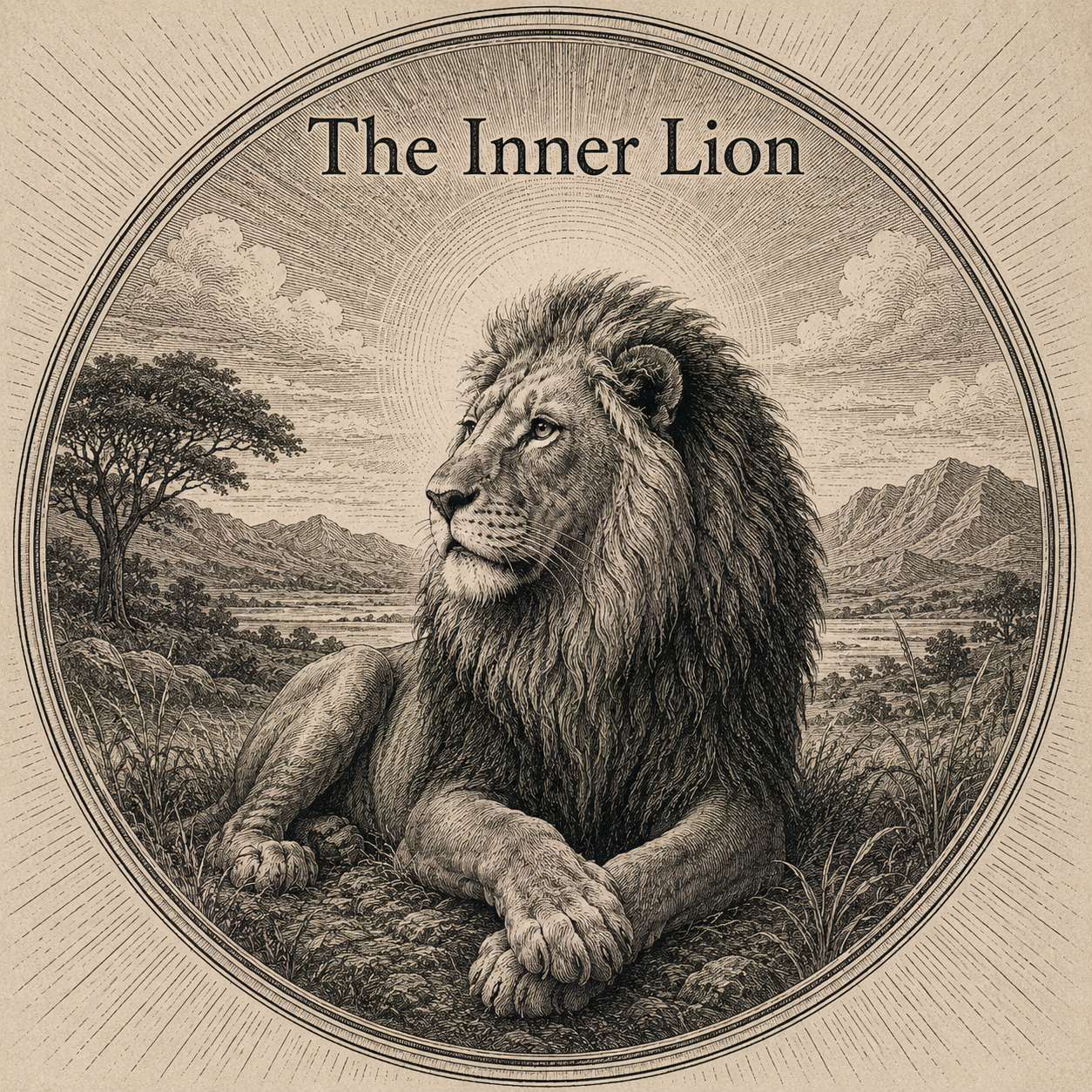
A friend recently questioned my use of the lion as the central metaphor in Tracking Triggers.
"When I think of lions," he said, "I think of aggression, dominance, and ferocity."
It was not the first time someone had raised the concern, and I understood it. The lion is usually cast as a symbol of force. The king of beasts. The predator at the top of the food chain. The one who roars.
But that has never been my lion.
What a Lion Does
Watch a lion for any length of time, and the first thing you notice is how little it does.
It lies in the grass, completely relaxed and completely alert. Most of its life is stillness. It does not waste itself proving anything to anyone. When it finally moves, it moves with total economy.
The roar, the part everyone pictures, is the smallest fraction of what a lion is. The rest is presence.
That is the lion that drew me. Not the predator of my friend's imagination, but the creature so at home in itself that it has nothing to prove.
This is the lion of presence.
It watches, and it waits.
It reads a reaction as a track, not a threat.
It knows a rustle in the grass from real danger.
It follows the trail one print at a time, without demanding the whole map.
It stands on its own ground and trusts what it sees.
It does not chase, and it does not look away.
It acts when clarity has ripened, and when it misses, it resets without collapsing.
It meets others as neither prey nor predator.
Others have described a similar presence in the language of psychology, and I follow that thread elsewhere. But the lion did not come to me from a clinic. It came first, from the bush, from a very old image, and from my own life.
It Was Always Mine
The truth is that the lion had been with me long before any book or any card.
I was born in southern Africa. As children we used to joke about how people from elsewhere imagined lions roaming our streets. They did not. But the big cats were never a fantasy either. There was always talk of the leopard in the gorge nearby, and in the game parks the lions were real. The association of that land with big cats was true, if not quite in the way outsiders pictured it. The lion belonged to the world I came from.
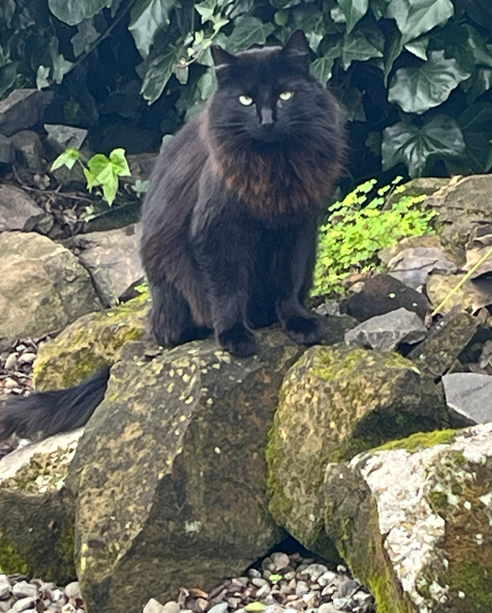
3rd Generation: L’Guy
I was born under Leo, the sign of the lion, and in the Chinese Year of the Tiger. Two unrelated traditions, the Western zodiac and the Chinese one, and each of them handed me a cat. I have never put much stock in such systems, yet I cannot deny a lifelong affinity with feline imagery.
For years I have fed a feral black cat who visits my property every day. I call him L'guy, short for Little Guy, the same name I gave his father, and his grandfather before that. Three generations, one name. I have never touched any of them. Our relationship exists entirely on their terms, and yet there is trust in it. Recognition. Familiarity. Presence.
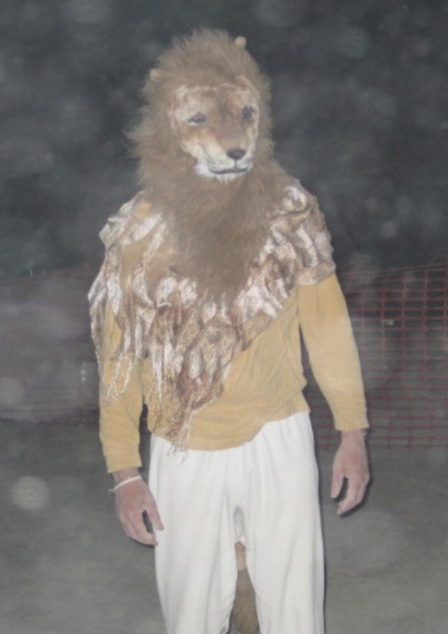
Burning Man, 2012
For seven years I attended Burning Man, often drawn, without quite knowing why, to feline masks and identities. Looking back, the pattern is hard to miss.
The lion was not a symbol I chose. It was a symbol that kept returning.
When I watch L’Guy sitting on the rocks outside my home, I do not see aggression. I see an animal completely relaxed and completely awake, occupying its place in the world without apology. I see presence.
And presence is the heart of everything I have tried to say in Tracking Triggers.
A Different Kind of Strength
The same recognition deepened when I began to study the Tarot with the Builders of the Adytum.
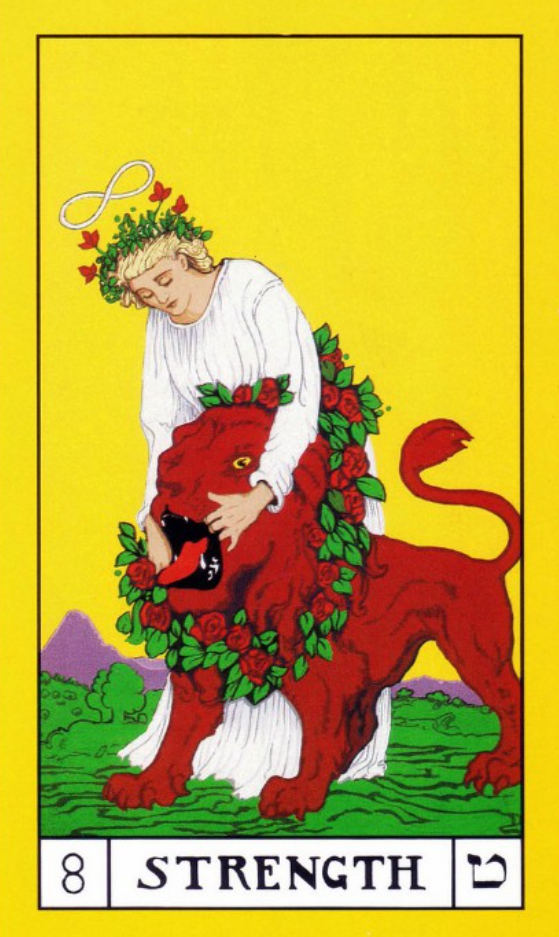
There, the card called Strength shows a woman and a lion. Her hands are not on the lion's head but at its open mouth. Above her floats a lemniscate, the sideways figure eight, the sign of a consciousness larger than the moment.
The card is widely misunderstood. What I learned is that it is not a picture of domination. The woman does not conquer the lion, and she does not force its jaws shut. She works gently at its mouth, the place where the roar lives, shaping its raw energy into something that can be spoken rather than unleashed. The lion remains every bit as powerful. What changes is that its power is no longer blind. It becomes available in the service of wisdom.
This is the opposite of aggression. It is primal force met through relationship.
And there is a detail I cannot resist. Strength is Key 8, and it is the lion's card. I was born on the eighth of August, the eighth day of the eighth month.
The Tracker's Lion
All of this was with me long before I had words for it. The words came late, and they came from Boyd Varty's book, The Lion Tracker's Guide to Life.
Varty learned tracking from master Shangaan trackers in the South African bush. The book is ostensibly about tracking lions. It is really about tracking ourselves. He describes the lion as the integrated self, the part of us that can move through life with presence rather than fear, awareness rather than reactivity.
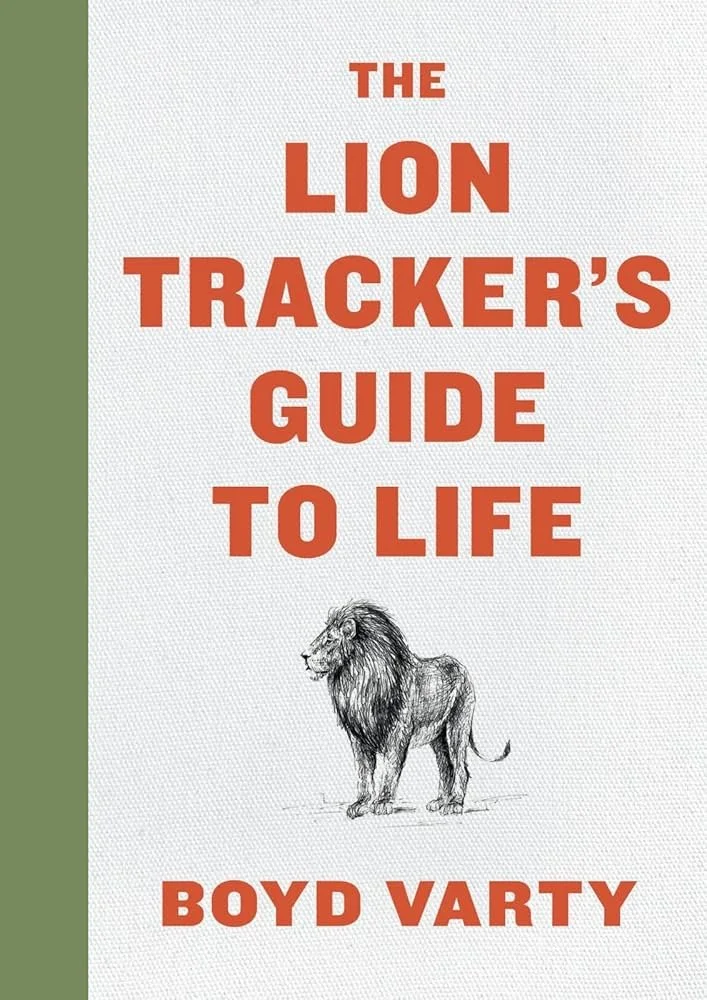
Reading him, I did not feel I was learning something new. I felt I was being handed a name for what I had carried all along. He distilled the lion into something clear and palatable, something I could finally offer to another person. Tracking itself I had met long before, through a different door, among the San of the Nyae Nyae in Namibia, where I watched trackers read the faintest signs in the bush. Varty gave me the other half of my title. I had wanted to write about triggers for years, and his Lion Tracker's Guide gave me the Tracking to set beside them. Tracking Triggers, it rhymed too well to refuse. But what he gave me above all was the lion.
The lion is the part of us that can notice a reaction without becoming it. It is what remains when the old protective strategies, the fight, the flight, the freeze, the fawn, no longer take the wheel.
The Inner Lion
I should be clear about what kind of thing the lion is. I am not claiming there is literally a lion inside you, waiting to be found. The inner lion is allegory. It is a mystical figure, a way of pointing at something that can be felt long before it can be defined, and perhaps never fully. It lives at the fringe of the known and the unknown, where the old trackers read the ground, where a tarot card speaks in images, where a sign and a number and a day line up for reasons no one can prove. I do not ask you to take any of it literally. I ask only that you notice what the figure gathers, and what it opens.
So when my friend pictures aggression, I understand why. But that was never the point.
The inner lion is not the part of us that overpowers others. It is the part of us that is no longer overpowered by ourselves.
It is not the roar. It is the stillness beneath the roar.
And it was never somewhere else, waiting at the end of the trail. It is here all along, showing up each time we pause instead of react. We do not become it once and for all. We meet it, again and again, and then we lose it, and then we track our way back.
That is the practice. Not arrival. Just the next step, and the next.
That is why the lion keeps calling to me. Not because it stands for power, but because it points to the deepest possibility in any of us: to meet life with awareness, with courage, and an open heart.
A Note on the Self
Many traditions have pointed at what I am calling the lion. Carl Jung named it the Self, the center of wholeness that lies beneath the ego and slowly draws the divided parts of a person into one. The contemplatives, from the Buddhist teachers to the sages of Vedanta, spoke of an awareness that watches the passing states without being caught in them. More recently, Internal Family Systems gives it the plain name Self, the calm and curious presence that remains when our protective parts relax. None of them describe it quite the same way. Each is its own map, with its own language and its own surrounding ideas, and the lion is one more. But the place they are all mapping, I think, is one: a steadiness in us that is not the wound, not the defense, and not the reaction.
And it is less a fixed thing to be reached than a territory we keep exploring, one that widens as our awareness widens and that no one ever finally maps. The question of who we are is not a problem to solve but a trail to track.
I do not offer the lion as a rival to any of these. I offer it as a companion. Each of these names, the lion among them, is a humble attempt to put words to something that stays largely ineffable, mysterious, a little beyond our reach. And I did not reach for the animal on purpose. As the rest of this reflection has tried to show, the lion simply arrived, by happenstance and a kind of mystical good fortune, and its gift was to lead us out of the familiar accounts of ourselves and let us think anew.
And what all these names point to is less a fixed thing to be reached than a territory we keep exploring, one that widens as our awareness widens and that no one ever finally maps. The question of who we are is not a problem to solve but a trail to track.
For the lion stands less for the self than for presence. Presence is the doorway. When we are present, what is steady beneath the reaction comes into focus, in whatever language your own tradition has given you, the Self, the witness, awareness. So take up the lion if it helps you arrive, or leave it for a name of your own. What matters is the presence, and the presence was always yours.
Continue the Journey
Tracking Triggers is more than a book. It is a living exploration of how we move from reactivity to responsiveness.
The Inner Trackers are a small community walking this path together, receiving occasional reflections, new journal entries, and a first look at the work as it unfolds.
If this resonates with you, I'd be glad to have you join us.