
Does the Body Keep the Score?
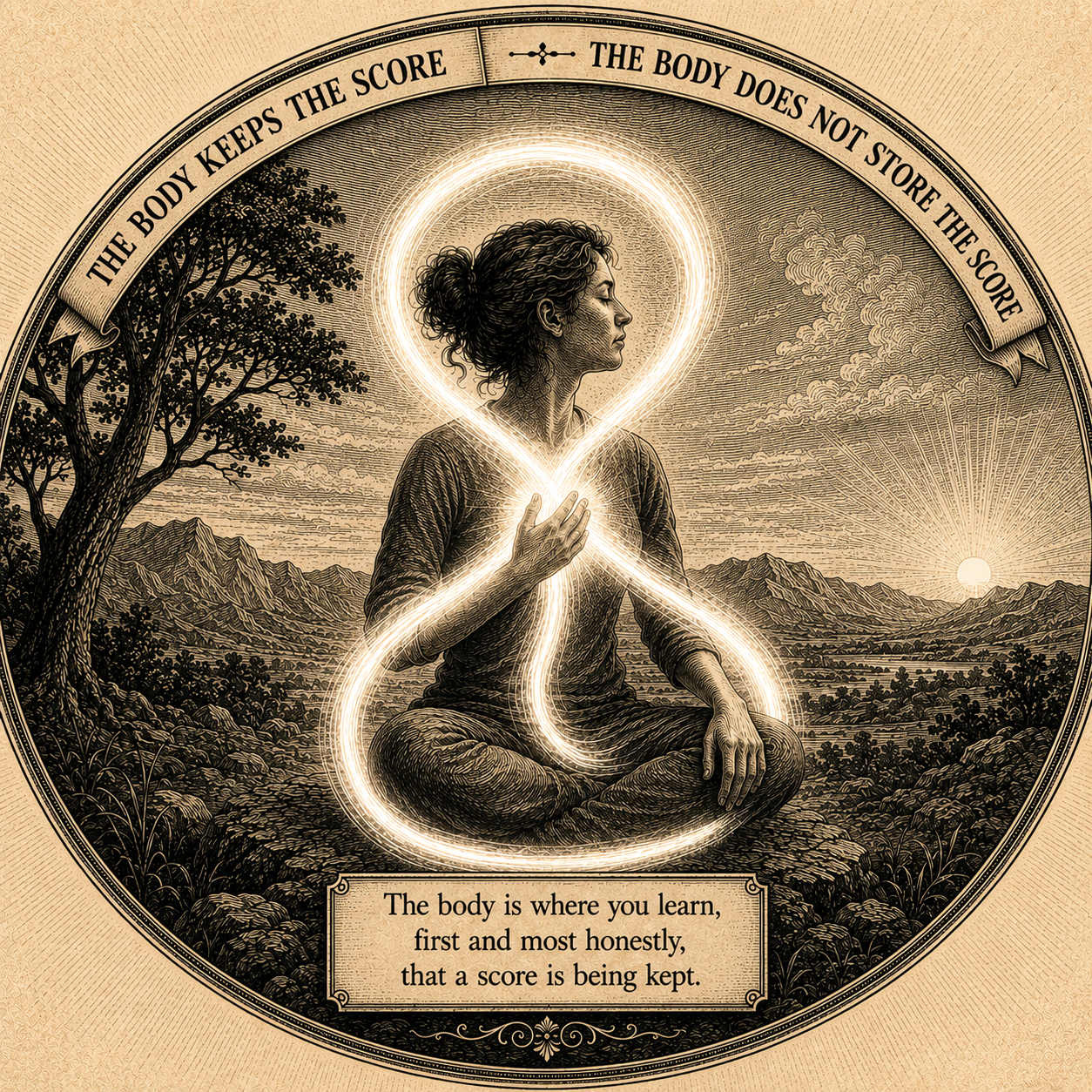
For years I've written and taught alongside a phrase almost everyone in this work knows: the body keeps the score. It comes from Bessel van der Kolk's book of that name, and it names something true that anyone who has been triggered can feel in the chest before they can put it into words.

The phrase invites a picture: memory filed away in muscle, held in tissue, waiting to be released. It's an intuitive image, and it's the reason so much good somatic work speaks of releasing what's stored in the body.
But the picture was never van der Kolk's own. His argument was phenomenological, clinical, and neurobiological all at once. He never claimed trauma lives in tissue independent of the nervous system. What has hardened, over years of wellness culture and social-media neuroscience, is a more literal reading of his title than the book ever made. That literal reading is the thing worth examining, and getting it right makes the work stronger rather than weaker.
Recently a group of neuroscientists published a paper with a title that seems to flatly contradict it: The Body Does Not Keep the Score (Kotler, Mannino, Fox, and Friston, 2026). They argue that trauma is not stored in bodily tissue at all. It lives in the brain's predictive machinery, where the system learns to expect an old danger and generates the arousal that expectation demands. The racing heart, the tight chest: not a vault being opened, but a prediction being run.
So which is it? Does the body keep the score, or not?
I've come to think the answer is both, and that the whole apparent conflict rests on a single hidden assumption.
We assume that to keep the score means to store it. That if the body is holding the record, the record must be filed away somewhere inside it, in the muscle, in the fascia, waiting to be released. Drop that assumption and the contradiction dissolves. Keeping score has never meant hiding the tally inside your body. It means having the account. Being the one who knows what happened and carries it forward.
That's what the body does. It carries the record. When something in the present rhymes with something old, the body is the first to let you know a debt is being called, that this moment is being charged against an account opened long ago. The tightening is real. The urgency is real. The body has brought the receipts.
What it hasn't done is store the memory in its tissue. And here's the piece that makes both statements true at once: the body and the brain are not two systems having a conversation. They are one system, and the body is where you notice it first.
If body and brain were separate, you would need the score written down somewhere, and "in the tissue" would be the obvious place. But there is no separation to write across. The nervous system runs through your gut, your heart, your skin. The prediction forms centrally and shows up peripherally, in one continuous loop. So when your chest goes tight before you know why, nothing has been retrieved from your chest. Your system has predicted an old danger and is generating what that prediction requires. The body isn't relaying a message from a storage site elsewhere. It's part of the one whole that keeps the account, which is exactly why it can hand you the receipts so fast.
I'm not alone in reading it this way. Writing in Psychology Today, trauma researcher MaryCatherine McDonald worked through the same paper and reached the same conclusion: despite its provocative title, it functions less as a rejection of embodied trauma work than as an attempt to refine its mechanisms. The paper targets the literalized cultural interpretation of "the body keeps the score," she notes, not van der Kolk's actual clinical model.
This is good news for the work, not a correction of it. Everything the somatic traditions have taught still holds. The body speaks first. Presence with sensation is where change begins. None of that depended on the memory being lodged in the muscle. What shifts is only the mechanism, and the shift makes the practice sharper.
Because if you believe the charge is stored in your shoulder, you go looking to drain it. But if you understand that your system is running an old prediction, you do something subtly different. You give it a new experience. You stay when you would have fled. You speak when you would have gone silent. And the prediction updates, because you have shown it, in the body, that this time the account settles differently.
So, does the body keep the score? Yes. It keeps it the way a faithful witness keeps it, not by storing the past in its tissue, but by carrying the record and showing it to you the instant it becomes relevant. The body does not keep the score in a vault. It is simply where you learn, first and most honestly, that a score is being kept.
And that is not a smaller role. It's the one that lets you do the work.