
When a Trigger Reveals a Part of Us Asking to Be Heard
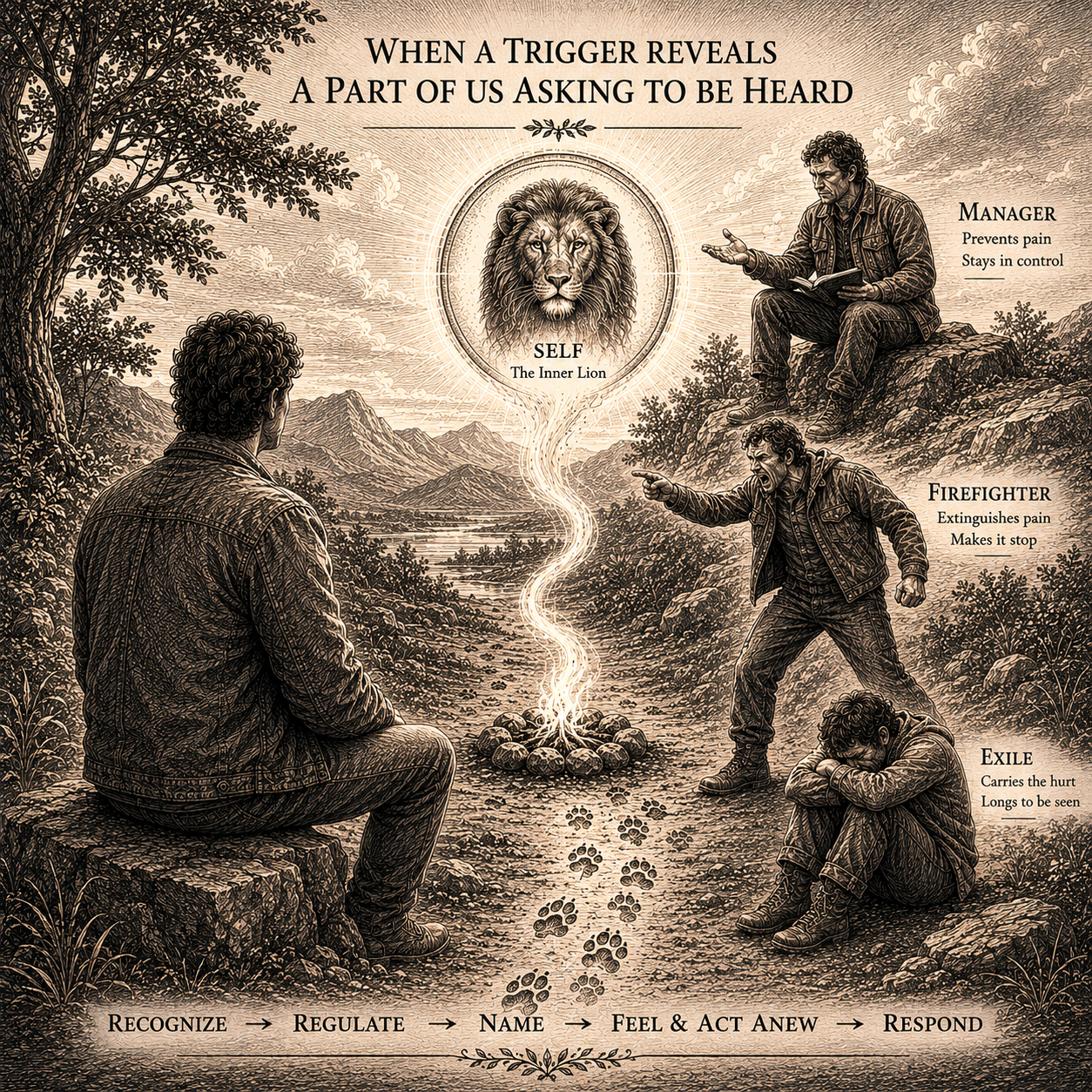
One of the great challenges of being triggered is that we often lose perspective. The reaction does not feel like something happening within us. It feels like us.
We don't think, "Anger has arrived." We think, "I am angry." We don't think, "A part of me feels afraid." We think, "I am afraid." The emotion, the story, and our sense of identity temporarily merge.
This is why the first movement in Tracking Triggers is to Recognize: to notice and accept what is.
It begins with a simple but profound shift. We notice what is happening. The heat in the body. The impulse to defend. The urge to withdraw. The familiar story forming in our mind.
By noticing, we create a small but powerful space. We are no longer only inside the reaction. We are also the one who can observe it.
This insight is also central to Internal Family Systems, developed by Richard Schwartz. IFS suggests that our inner world is made up of different parts that carry feelings, beliefs, memories, and protective strategies. When a part is activated, we can become blended with it. We temporarily see the world through its eyes.
IFS describes three broad categories of parts.
Some parts are managers. Their job is to prevent pain before it happens. They organize, plan, perfect, please, control, achieve, or avoid. They try to manage life so that vulnerable places inside us are never touched.
Other parts are firefighters. They arrive after pain has already been activated. Their job is to put out the emotional fire as quickly as possible. They may distract, numb, attack, escape, shut down, or seek immediate relief.
And beneath these protective parts are often exiles. These are the younger, more vulnerable parts of us carrying experiences we have not fully integrated: shame, fear, grief, rejection, abandonment, or the belief that we were somehow not enough.
From the perspective of triggers, this makes sense.
Being triggered is often not just a reaction to what is happening now. It is a protective part responding because something from before has been touched.
The manager says:
"Never let this happen again."
The firefighter says:
"Make this feeling stop."
The exile says:
"This still hurts."
Recognizing allows us to notice who has arrived.
But noticing alone is rarely enough.
When a part is activated, our nervous system is often activated too. The body prepares to fight, flee, freeze, or appease. We need the second movement: Regulate.
It helps us return to center. We breathe. We pause. We create enough internal safety that we can relate to the part rather than be consumed by it.
IFS might describe this as becoming less blended. Tracking Triggers describes it as returning to the Tracker's Now.
The Tracker's Now is the fullness of the present moment, the only place the trail can actually be read.
We are no longer lost in the old terrain, in what happened then.
We are here, in the Tracker's Now.
And from here, we can listen.
This leads naturally to the third movement: Name.
Every part carries more than a reaction. It carries feelings and needs. It also often carries a story.
The manager who criticizes us may be carrying fear and a need for acceptance.
The firefighter who lashes out may be carrying hurt and a need for protection.
The exile who feels unworthy may be carrying grief and a need for belonging.
Here we follow the trail beneath the strategy, to discover what the part is guarding and what it needs.
Naming also brings this home to ourselves, in the present. We ask what we are actually feeling now and what we actually need now, and we look for the words that match the inner experience with precision.
Part of naming is discernment. Much of what arrives in a triggered moment is story, an interpretation the mind generates from old pain. The story is the smoke, not the fire.
So we ask: Is this a fact, or a story I am telling? What am I feeling now, and what does it need?
Often the reaction carries needs from then as well as now. Naming begins to tell them apart.
The question changes.
Not:
"What is wrong with this part of me?"
But:
"What is this part trying to protect?"
Only after we recognize, regulate, and name can something new happen. The fourth movement: Feel and Act Anew.
This movement separates the present from the past. We feel what was left unfinished, the old need that never got met, and then, when the familiar reaction returns, we act from present awareness rather than from the strategy that once kept us safe.
This is where IFS offers an especially important reminder.
Healing does not come from eliminating parts.
The angry part does not disappear. The anxious part does not get thrown away. The protective part that helped us survive is not fired from the team.
Instead, our relationship changes.
A part that once had to take over can begin to trust that it does not have to carry the burden alone.
The goal is not control. It is integration.
The part remains, but its role evolves.
The same energy that once defended us can become discernment.
The same sensitivity that once overwhelmed us can become compassion.
The same vigilance that once scanned for danger can become wisdom.
We feel differently because we relate differently. And because we relate differently, we can act differently.
That brings us to the final movement: Respond.
In IFS, Schwartz describes Self as the core of who we are, the seat of awareness that exists beneath our protective reactions. When we are connected to Self, he suggests we naturally experience qualities he calls the eight C's: calm, curiosity, clarity, compassion, confidence, creativity, courage, and connectedness.
This is the same place Tracking Triggers points to, though it comes at it from a slightly different angle. In the language of the book, the presence beneath our reactions is the Inner Lion: the integrated self who can feel without being hijacked and speak the truth without blame or collapse. The lion does not exile the vulnerable parts or attack the protective ones. It brings curiosity to the strategies working so hard to keep us safe, compassion to the old wounds still asking for attention, and clarity to the reactivity scrambling to numb the pain. It does not track as prey or predator. It tracks with sovereignty, grounded, clear, and curious.
The lion stands, above all, for presence, and presence is what makes the rest possible. When the lion is present, what IFS calls Self comes into focus, and the eight C's arrive with it. The two are not rivals but companions, meeting at the same place: who we are when no part has taken over.
The goal is not a life without triggers.
The goal is not a life without parts.
The goal is to live from that presence, so that when our parts appear, we can meet them with awareness rather than become them.
The trigger that once sent us spinning into the past becomes a doorway back to ourselves.
Continue the Journey
Tracking Triggers is more than a book. It is a living exploration of how we move from reactivity to responsiveness.
The Inner Trackers are a small community walking this path together, receiving occasional reflections, new journal entries, and a first look at the work as it unfolds.
If this resonates with you, I'd be glad to have you join us.