
The Stitched Account
Fourth in a series on the past, presence, and the work of tracking
The first three posts in this series were about the deep past. The pain that surfaces to be felt. The sweet memory we flee into when the present aches. In each, the past we reached for was finished, settled, some distance behind us.
This one is about a past that is barely past at all. Because the strangest revision of memory does not take years. It can happen in seconds.
You are in an argument. Your partner says, "You said you'd handle it." And you think, no I didn't, that is not what happened. You are both standing in the wreckage of the same ten minutes, and you already hold different records of it. Neither of you is lying. The divergence is immediate, sincere, and invisible to you both.
This is the first thing to understand, and it is oddly freeing. Memory is not a recording we play back. It is an account we stitch together, every time, from fragments. The record was always incomplete. We never took down the whole of what happened, only pieces, and when we return to the memory we knit those pieces into something whole. We do it honestly, with no intent to deceive, often without any awareness that we are doing it at all. The mind abhors a gap, so it fills one.
If that were all, it would be harmless. A little humility about our records, and we could compare notes and find our way. But something happens when the moment carried a charge.
When the event touched an old echo, some tender place from long before, the stitching is no longer neutral. It develops a pull. We return to the memory, and return again, and each return quietly works the record toward something that eases the echo. We are not trying to falsify anything. We are trying to soothe a hurt. But soothing the hurt can mean bending the account, smoothing our own part, dimming the detail that stings, until the version we hold is the version that lets us rest. The wandering mind, doing its best, wandering toward relief.
And sometimes the bend goes further. Sometimes the easiest way to quiet an echo is not to soothe it but to slam it shut, and blame is the fastest door. If the other person was the wrongdoer, then whatever we did was justified, the account is settled, and the pain has somewhere to go that is not us. The story hands us a villain and a clean conscience in the same motion. And it is satisfying, that version. Being wronged gives permission. It makes us the good one. That satisfaction is not incidental. It is the glue. The pleasure of the blaming account is part of why it sets and holds.
None of this is malice. The mind is not scheming. It is doing what minds do, filling gaps, easing pain, reaching for the fastest relief. The wild wandering through a hall of mirrors, reflections of reflections, until we can no longer tell which image was the thing itself.
But here is where I want to be careful, because the absence of malice is not the absence of responsibility.
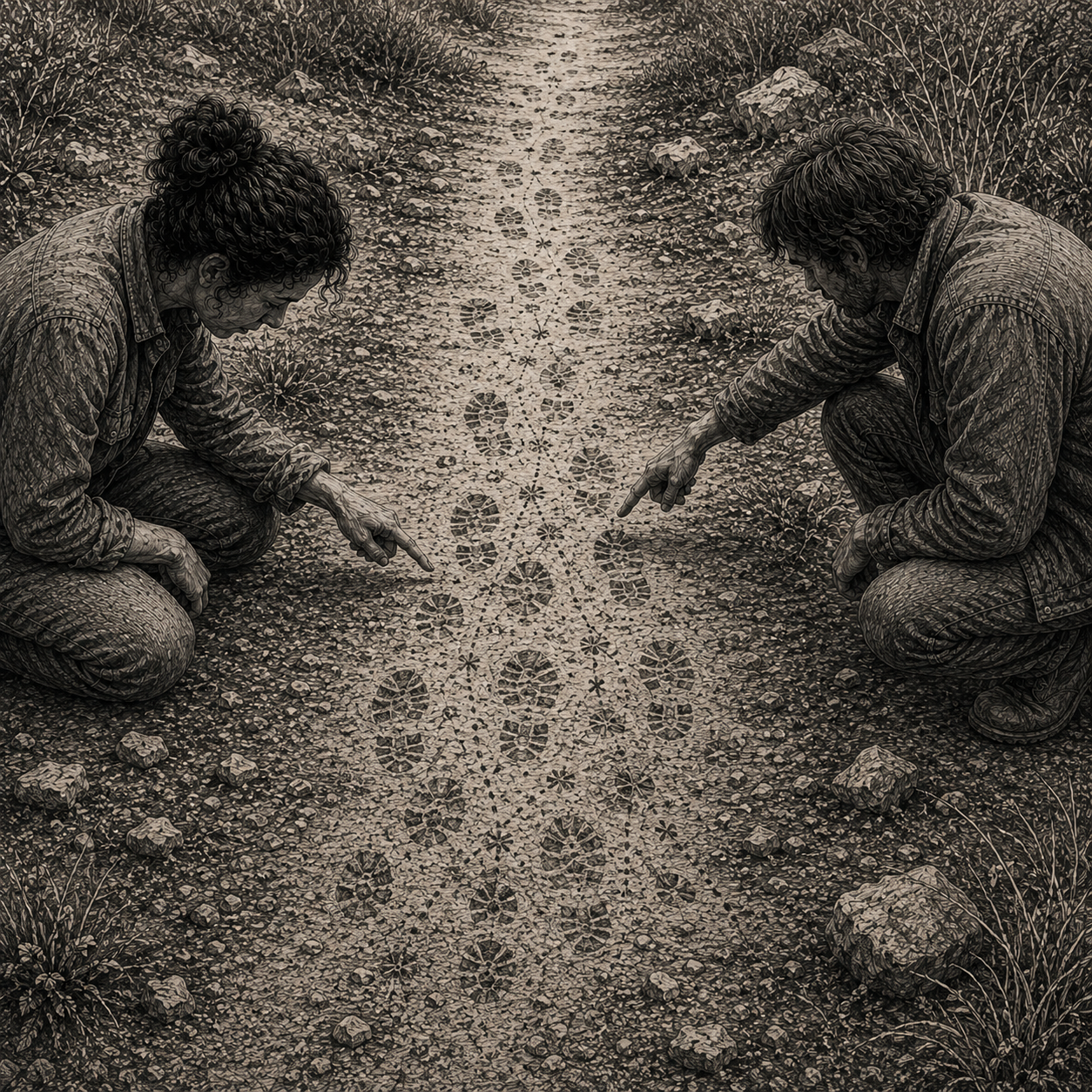
The record bends on its own. That part is not our fault. What is ours is the work, the looking, the testing of the bent version against what actually happened. And when we skip that work, when we let the soothing version stand because it comforts, or the blaming version stand because it justifies, that is a failure. Not a lie. A negligence. We did not do our tracking. We accepted the convenient print instead of kneeling down to read the true one.
This is the discipline the tracker brings. Not certainty, because with a charged memory the full truth is often genuinely beyond recovery. The record really was incomplete, and some of it really is lost. So the tracker does not claim the perfect account. The tracker holds his own version lightly, knowing it was stitched, knowing it bent toward his tender places, knowing the other person is sincerely holding a different stitched version of the same lost ten minutes.
But holding it lightly is not the same as shrugging. Humility is not an excuse to stop looking. The tracker's tell is the version that resolves too neatly, the memory that both justifies him and closes the pain in a single stroke. When an account is that convenient, the convenience itself is the sign. The stitching has bent. And the work is not to flip into self-blame, which is only the same machinery turned inward, but to keep the account open, to let the echo stay alive long enough to be felt rather than forced shut.
Groups do this too, and faster than we would like to think. A shared grievance gets stitched into a clean story, we were wronged, they are to blame, and the version that justifies and soothes becomes the version a whole community carries. The record bends at scale, and the failure to test it does too.
The echo, in the end, is the same invitation the whole series has been circling. Something from the past is asking to be felt. Fleeing into a sweet memory declines it. Forcing it shut with blame declines it too, faster and at someone else's expense. The tracker does the slower thing. He reads what the track actually shows, including the part that implicates him, holds the rest with humility, and lets the charge move through rather than discharging it onto a villain.
The story said the other person did this to you. The truth was a moment, incomplete, that you have been stitching ever since. Kneel down. Read the real print. Then keep walking. The trail is now.
Continue the Journey
Tracking Triggers is more than a book. It is a living exploration of how we move from reactivity to responsiveness.
The Inner Trackers are a small community walking this path together, receiving occasional reflections, new journal entries, and a first look at the work as it unfolds.
If this resonates with you, I'd be glad to have you join us.