
The Track Is Not the Animal and the Trigger is not the Wound
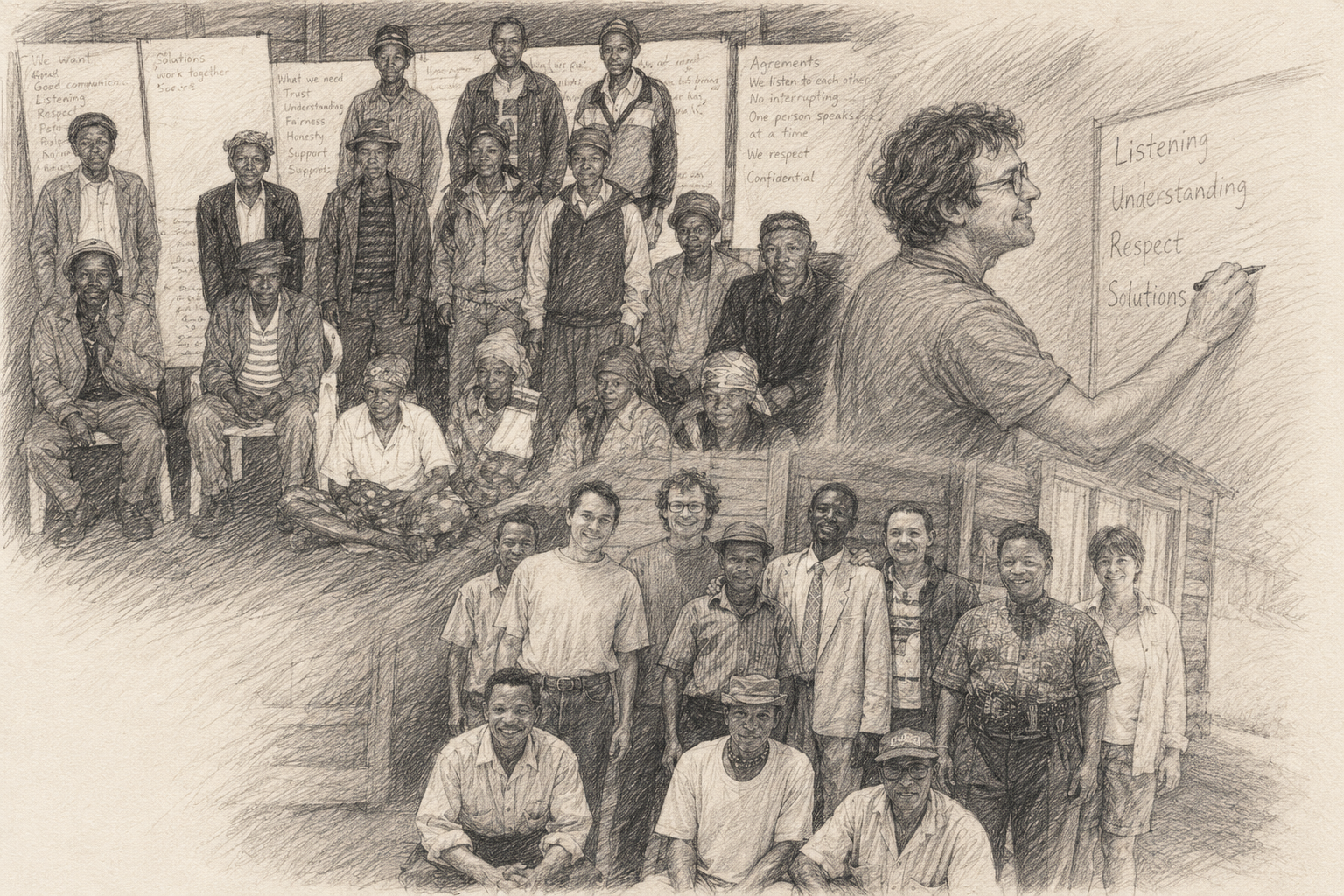
The Board and Workshop Participants
In 1999 I was in the Kalahari, running a conflict resolution workshop with the Ju/'hoansi of the Nyae Nyae Conservancy. Many of the participants did not read or write, so I turned concepts into drawings and theory into pictures. What stayed with me had nothing to do with the curriculum I had prepared. It came afterward, out on the land,
I am standing on the sand, watching a man named Thomas track a gemsbok. He moves like breath across the land, focused, present, attuned to signals I cannot see. Where I see stones and grass and scrub, he sees a trail. A faint impression in the earth. A stone slightly displaced. A bent blade. I barely breathe. Something opens in my chest.
Thomas did not get the gemsbok.
I had read Louis Liebenberg's The Art of Tracking a few years before, so I arrived in Nyae Nyae already curious. Watching Thomas was a different order of thing from reading about it. I did not understand what I had witnessed, only that it was magical and that I wanted it. That afternoon eventually became part of the story behind Tracking Triggers.
I found myself back in the Kalahari in my mind recently, reading an essay by the South African activist Jay Naidoo about his time with iGubi, a !Xõ elder and shaman. Naidoo is not writing about tracking. He writes about indigenous knowledge, reciprocity, our relationship with the natural world, and the deep woundedness he sees in South Africa and in human beings more generally. Still, his piece took me back to what the Kalahari taught me. I did not come home a tracker. I came home aware of how much there is to see, once we learn to pay attention.
The Map, the Agreement, the Track
A track tells you that something has happened. It may tell you what passed this way, perhaps when, perhaps in which direction. To a skilled tracker it can reveal things the rest of us would never guess could be known from so small a disturbance.
And still, the track is not the animal. It is a sign.
Alfred Korzybski put it in the form most of us know. The map is not the territory. A map represents a place and helps us move through it, and confusing the representation with the reality is a basic error.
In my years of mediating I have run into a version of the same thing. The agreement is not the relationship. People leave a mediation with a beautifully drafted agreement and a relationship that is still in pieces. Other times something real shifts between two people while the agreement they sign looks modest on the page.
I have come to think triggers work this way too. The trigger is not the wound.
Two Sets of Tracks
When we are triggered, our attention goes straight to what just happened. She criticized me. He interrupted me. They left me out of the meeting. She still has not answered my email.
That event is real and it matters. It is also only the first sign, and it tells us less than we assume about what it landed on.
The second set of signs is closer to home. The clenched jaw, the tightening in the chest. The rush of anger and the urge to defend ourselves. The thought, he does not respect me. The hurt that travels with the anger. The longing to matter, to belong, to be respected, to be safe.
These are tracks too, and they are ours.
We Stop Tracking
Here is where it tends to go wrong. We find the first track and treat it as the animal.
He does not respect me becomes the truth of the matter. She betrayed me becomes the truth of the matter. They do not care about me becomes the truth of the matter.
Interpretation itself is fine. Trackers interpret constantly, and reading a sign is already an act of interpretation. What costs us is seizing on the first reading, deciding we know what happened, and stopping there.
What Happened Here? Reading a Trigger in Context.
A good tracker does not find a mark and announce what it means. A sign gets read in context. Other signs matter. The terrain matters. What came before matters.
Emotional tracking asks something similar of us. Instead of acting straight out of the reaction, we get curious about it.
What just happened? What happened in me? What story did I tell myself, and how fast? What am I actually feeling? What matters to me here that I did not know mattered this much?
And sometimes, further along the trail, why does this particular track feel so familiar?
Not every strong reaction comes from childhood, and not every disagreement hides an old injury. Sometimes anger is about what is happening right now. Sometimes someone really has crossed a line. Tracking does not explain the present away with the past. It makes us more discerning about what belongs to now and what we carried in with us.
Woundedness
Naidoo writes about a deep woundedness, and about going back in time if there is to be real healing. I am drawn to that, and I want to hold it carefully.
The past does not sit inside us like an object waiting to be dug up. It also does not vanish because the event is over. We learn from experience. Our nervous systems turn what we learn into expectation. And so we become finely tuned to certain signs, because once, somewhere along the trail, those signs mattered.
Then something happens today. A look. A tone. A silence. A remark that lands harder than it should. There it is, a track.
Our reaction may be telling us something about the person in front of us. It may be telling us something about the path we walked to get here. Usually, I suspect, it is some of both.
And the animal at the end of the trail is not always a wound. Often it is something we care about, still alive and still asking for attention.
Becoming Trackers of Our Own Experience
The San's tracking traditions are not mine to claim. I lived and practiced law in Namibia, represented San communities as a lawyer, and served as chairperson of the Nyae Nyae Development Foundation, which supported the Ju/'hoansi in holding on to their land and their way of life. None of that makes the tradition mine. What I carry is what the encounter opened in me.
Being triggered can feel like an emergency, and the trigger like an enemy. Something to avoid, to eliminate, or to pin on the person who caused it. I have come to see the trigger as information instead. A disturbance in the terrain. Evidence that something passed this way before.
Thomas did not get the gemsbok, and the afternoon lost nothing for it. What I watched was a way of paying attention, and the attention was the whole of it.
Healing starts, I think, when we stop confusing the track with the animal, the map with the territory, the agreement with the relationship. It goes on when we get curious enough to follow the signs. We may never corner the thing. Following it is already the practice.
End Notes
A note on naming: "San" is the most widely recognized term in contemporary literature, and it is an imperfect one. In 2003 representatives of San peoples stated their preference for specific group names, such as Ju/'hoansi, !Kung, ǂKhomani or Hai||om. I use those where I can and "San" where I am speaking more broadly.
The San communities of southern Africa continue to face threats to their land, culture and survival. Readers who want to learn more or offer support can visit the Kalahari Peoples Fund (kalaharipeoples.org) or the Nyae Nyae Development Foundation of Namibia (nndfn.org).
Jay Naidoo's essay, "Encounters in the Kalahari unlock secrets of our healing and reconciliation," was published in the Daily Maverick in July 2018.