
The Body Is Deeply Involved. It Just Isn't a Storage Locker.
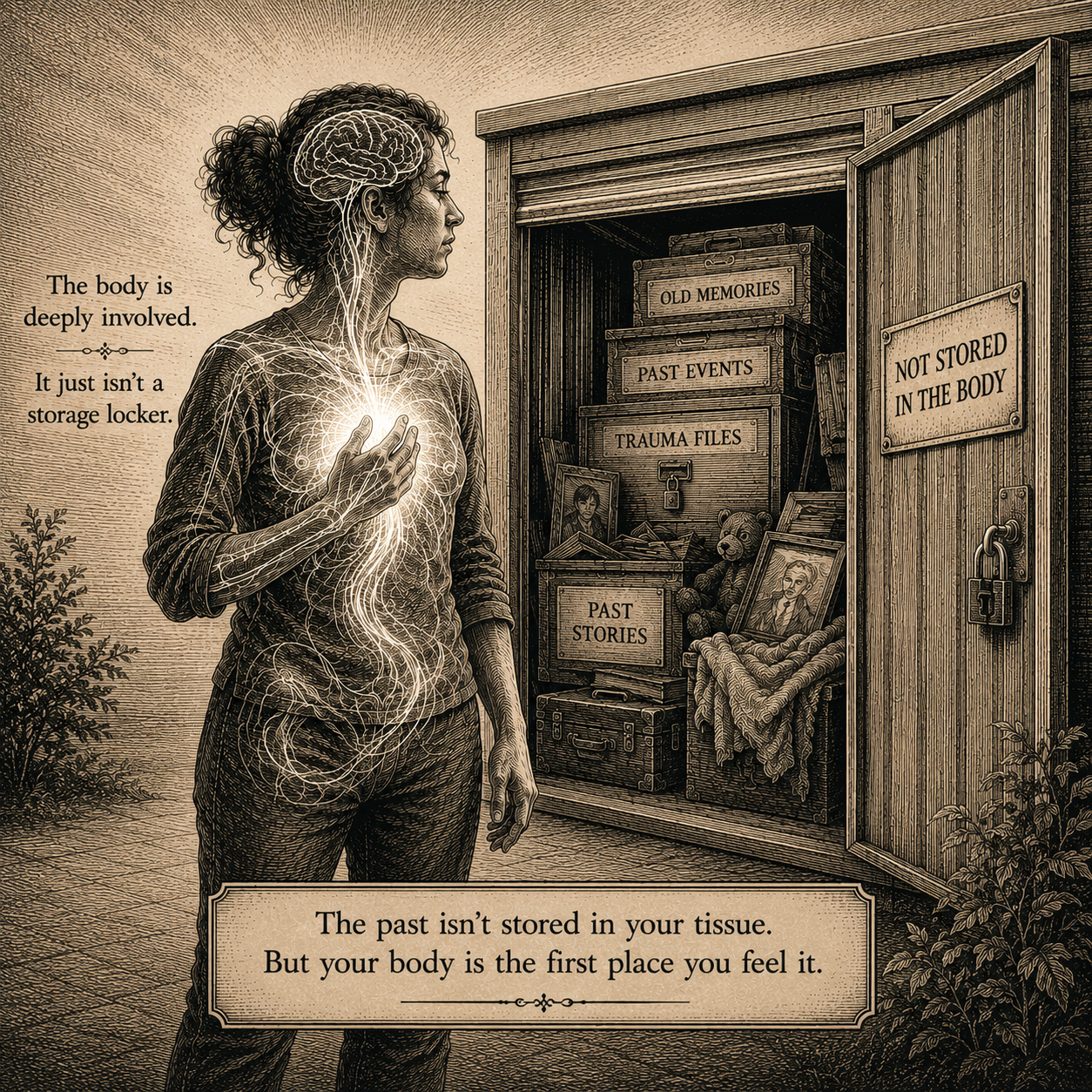
In a recent post I worked through a question that turns out to confuse a lot of us, myself included until I sat with it: does the body keep the score, or not? The short version I landed on was that "the body keeps the score" and "trauma isn't stored in your tissue" are both true, once you stop assuming that keeping the past means filing it away in the muscle. The past isn't stored in your body. But your body is the first place you feel it.
I want to come back to it, because that first post could leave a wrong impression, and I'd rather clear it up in the open, especially for the somatic practitioners whose whole craft is the body. If the past isn't stored in the tissue, someone could reasonably hear me saying the body is just a screen the brain projects onto. A messenger with nothing of its own. That's not what I mean, and it isn't true. The body's involvement is deep, specific, and real. Let me show you how, with an example that makes the whole thing click.
Phantom limb pain.
A person loses a leg. The leg is gone. And yet they feel pain in it, vivid, located, sometimes excruciating, in a limb that no longer exists. Where is that pain, if not in the leg? There's no leg to hurt. The pain is generated by the brain's map of the body, which still expects the limb to be there and produces the sensation that expectation calls for.
Two things are true at once, and you have to hold both. The pain is completely real. Nobody would tell an amputee their agony is imaginary. And the pain is not coming from tissue damage in the leg, because there is no leg. Real, and predicted. Both.
That is the whole idea in one physical, undeniable case. If the nervous system can produce a vivid, specific, bodily experience with no current tissue source, then a flinch, a clenched gut, a chest that tightens before you know why can also be produced by an old expectation rather than by anything happening now. The body isn't lying to you. It's expressing what your system has learned to expect.
Now, here's the part I most want the somatic world to hear: none of that makes the body peripheral. The expectation forms centrally, but it is lived in the body, and the body's involvement is intricate.
Look at posture. A system that learned the world isn't safe doesn't just think anxious thoughts. It braces. Shoulders climb toward the ears. The chest curls to protect the soft front. The jaw sets. Someone who spent years making themselves small under threat carries it in the spine long after the threat is gone. That posture isn't a memory stored in the shoulders. It's a protective prediction, running continuously, expressed as muscle and bone. You can see a person's inner history in how they hold themselves, not because the history is filed in the muscle, but because the whole system, one system, is organized around what it expects, and posture is where that organization shows.
Look at breath. Breath is the fastest tell there is. Threat shortens it, high and tight in the chest. Safety lets it drop low and slow into the belly. You don't decide this. Your system reads the moment and sets the breath to match its expectation, often before your conscious mind has any idea what it picked up on. This is why breath is such a powerful doorway in somatic work: change the breath and you send the system new evidence about whether it's safe, and the expectation begins, slowly, to shift.
And notice how consistent the routes are. The same kind of activation tends to travel the same path in you. For one person, threat reliably lands in the gut. For another, the throat closes. For another, heat floods the chest. That consistency can look like proof that the memory is stored in that body part, but it isn't. It's that your nervous system, which runs through your gut and your throat and your heart as one continuous network, has a habitual way of expressing a given expectation. The route is well worn. The memory isn't sitting in the gut. The gut is where that particular prediction reliably comes out.
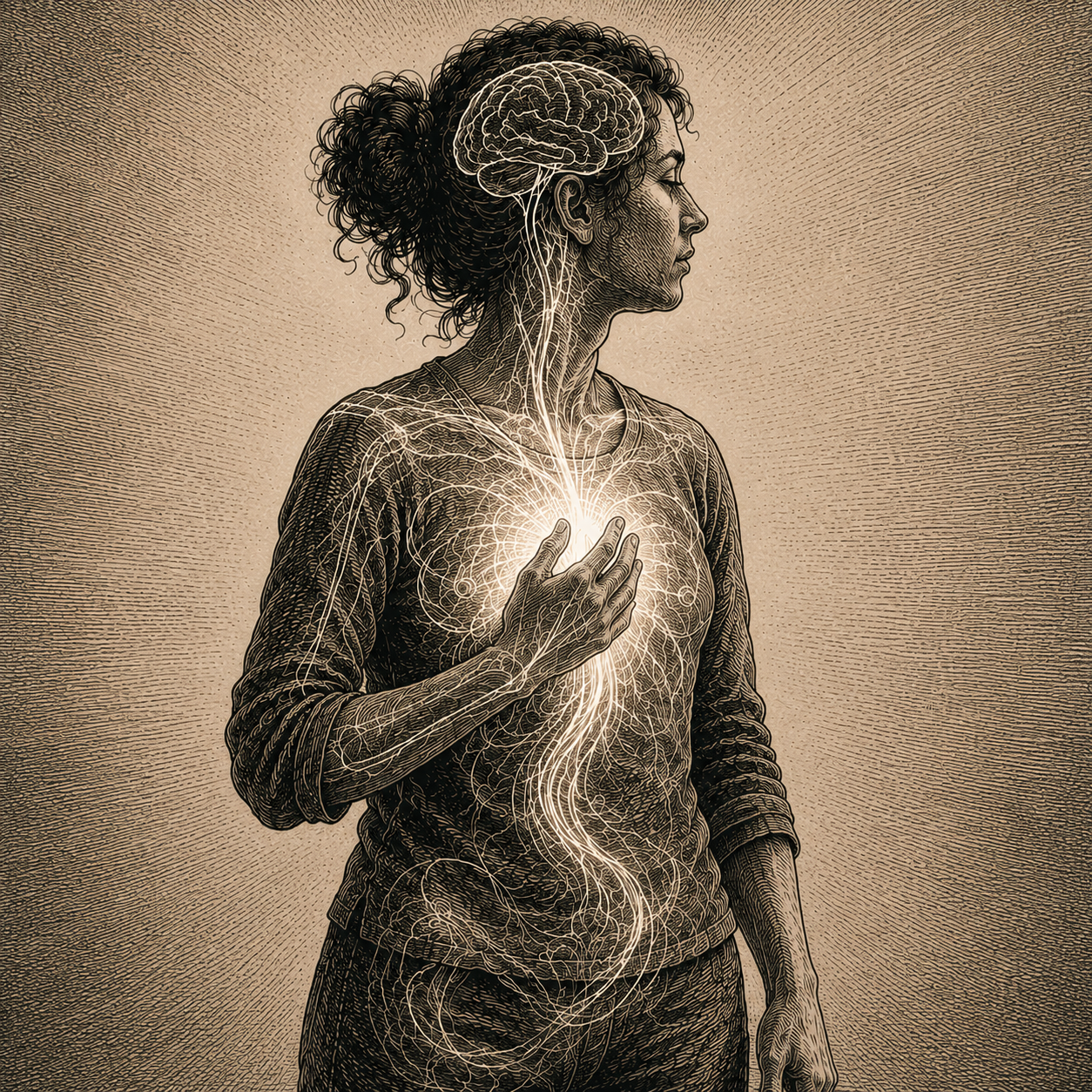
The nervous system doesn't stop at the skull. It runs through all of you. What you feel in your chest is the same system that does the predicting.
This is the piece that dissolves the whole confusion. Brain and body were never two systems having a conversation, one storing and one reacting. They are one system. The nervous system doesn't stop at the skull. It runs through the whole of you. So when your system expects an old danger, that expectation is central in origin and bodily in expression at the same time, because there is no border between the two for it to cross. The body isn't downstream of the mind. It's part of the one thing that does the predicting.
Which is why, I think, the somatic traditions have been right about so much, even when the mechanism was described with a metaphor that got taken too literally. The body does speak first. Presence with sensation is where change begins. Working through the body reaches things that talking about them never touches. All of that holds. What changes is only the story of why it works. Not because you're draining something stored in the tissue, but because you're giving one integrated system new experiences, in the only language it feels directly, until it updates what it expects.
The body isn't broken, and it isn't a filing cabinet. It's the living, sensing edge of a system that learned something once and can learn something new. That's not a smaller role for the body. It's a truer one.
I'm offering this in the spirit of the first post: not to correct anyone, but to clear up a confusion I found genuinely hard myself, so we can keep talking about it well. If you work with the body for a living, I'd love to know where this lands for you.