
Storied Feelings: Why I Landed Here
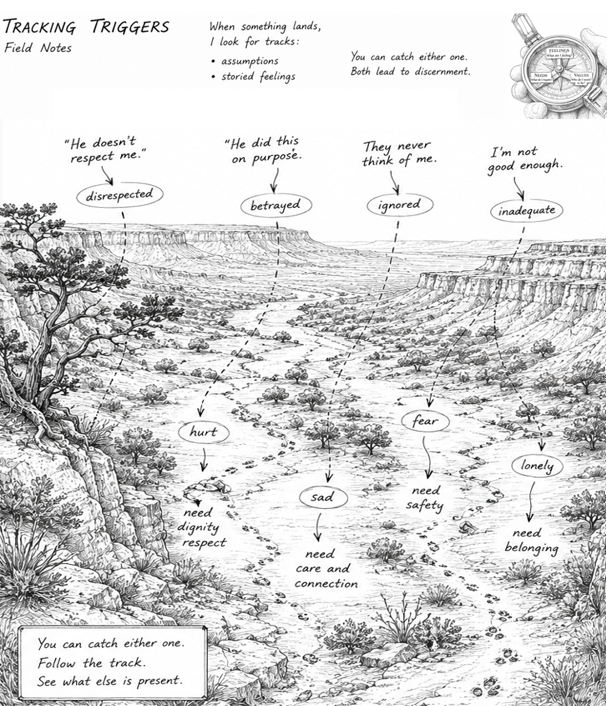
“The stories we tell ourselves about our pain shape our experience of it." — DailyGood, inspired by Maria Popova
If you've been following this journey, you know I've been searching for a replacement for "faux feelings."
The search is over. I've landed on storied feelings.
This post is about why.
The Problem with Faux
"Faux feelings" has served the NVC community for decades. Marshall Rosenberg used it to name expressions like "I feel disrespected" or "I feel ignored," words that carry an interpretation about what someone did to you.
But "faux" means fake. And no matter how carefully you define it, that's what people hear.
The problem runs deeper than connotation. Through dialogue with early readers, I realized something that changed the question entirely.
Damasio defines a feeling as "the private, mental experience of an emotion." By that definition, "I feel disrespected" IS a feeling. It's a subjective interpretation of an emotional state. It's real. The person isn't confused or lying. They're reporting what they experience once the mind has made meaning.
What makes these feelings distinct isn't that they're fake. It's that the interpretation often carries judgment and blame. "I feel disrespected" doesn't just name an inner state. It implies a conclusion about what someone did, and often, about who they are.
When we tell someone the word they used isn't actually a feeling, we invalidate. "Faux" does exactly this. Any replacement term must honor that the experience is real, while helping people see where the language points.
A Widespread Concern
I'm not the first to struggle with this term.
The Asheville Center for Compassionate Communication calls them "non-feeling words." Some trainers use "finger-pointing feelings." Others say "umbrella feelings" or "interpretive feelings." Marshall himself referred to them as "thoughts masquerading as feelings."
Each attempt signals the same discomfort: "faux" isn't quite right. The community has been circling this problem for years. No single alternative has taken hold.
The Journey: From Story to Storied
"Story feelings" emerged as the front-runner. It captured something essential: these feelings carry a narrative about cause. "I feel disrespected" isn't just naming an inner state. It's telling a story about what someone did.
But "story" kept triggering an objection: it sounds fictional. Made up. Not real.
I tried to define my way out of it. "By story, I don't mean something made up. I mean the meaning your mind creates about what's happening." That helped. But the friction remained.
Then a reader pushed me to reconsider "storied."
At first I resisted. But I couldn't shake it.
The "-ed" Insight
Here's what caught me.
There's an informal rule in NVC circles: if a feeling word ends with "-ed," beware. You're probably dealing with a faux feeling. I first heard this years ago, and it stuck.
I looked at my typology. 21 of the 25 feeling-words end in "-ed."
Ignored. Controlled. Rejected. Betrayed. Disrespected. Abandoned. Manipulated. Excluded. Silenced. Criticized. Judged.
That "-ed" carries weight. It implies something done TO you. The grammatical form encodes the victim position.
"Storied" uses the same ending but shifts the frame. Not something done to you. Something carried with you. Accumulated meaning. History layered in.
"A storied career" doesn't mean someone made it up. It means it carries rich experience.
"Storied feelings" works the same way. These are feelings shaped by accumulated meaning, carrying a narrative about cause. The "-ed" ending echoes the pattern while reframing it.
What "Storied" Captures
I pressure-tested both terms against a set of criteria:
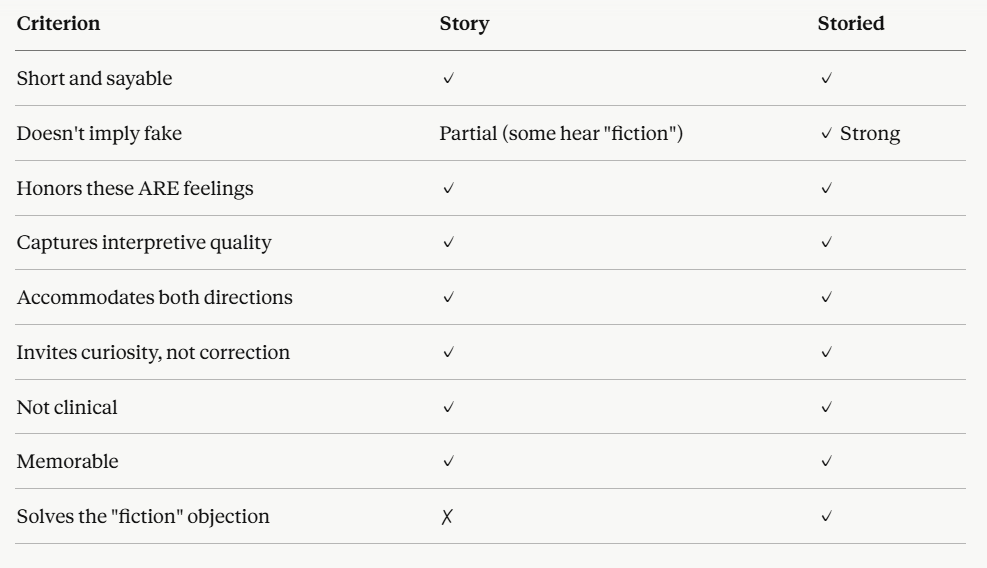
"Storied" passes where "story" stumbles.
Both Directions
One more thing the community helped me see.
I originally framed these feelings as outward-pointing: interpretations about what someone did to me. "I feel disrespected" = they crossed my boundary. "I feel betrayed" = they broke our agreement.
But some point inward.
"I feel worthless" = I am fundamentally flawed. "I feel inadequate" = I'm not good enough. "I feel like a failure" = I can't do anything right.
These aren't about what someone did. They're verdicts about who I am. The defining feature isn't direction. It's that the word carries an interpretation about cause, a narrative embedded in the language itself.
"Storied" accommodates both. Something carried with you, whether the story is about them or about you.
"Story" Still Comes Along
Here's the good news: "story" doesn't disappear. It does the work in the moment.
"That sounds like a storied feeling. What's the story there?"
"Storied" names the concept. "Story" invites the exploration.
The Definition
.A storied feeling is a feeling that carries an interpretation about cause, often layered with judgment or blame.
By storied, I don't mean fiction. I mean accumulated meaning, a narrative your mind has created about what's happening.
Most storied feelings point outward, toward what someone else did. Some point inward, toward who you believe you are. The experience behind both is real. The word choice shapes where attention goes.
Storied feelings aren't errors to correct. They're clues. Tracks on the trail that point toward something worth exploring.
Gratitude
This landing didn't happen alone. Dozens of early readers pushed, questioned, and pressure-tested. Some defended "faux." Some proposed alternatives. Some simply said, "That doesn't land for me," and trusted me to keep searching.
This is what community does. It holds the question until the answer earns its place.
What's Next
The book is close. The feedback window is closing. But the conversation continues.
If you've been following along, thank you. Your voice is part of this.
And if "storied feelings" lands for you, I hope you'll carry it forward. Use it. Test it. See if it does the work.
That's how language earns its place. Not by being declared, but by being used.
Continue the Journey
Tracking Triggers is more than a book. It is a living exploration of how we move from reactivity to responsiveness.
The Inner Trackers are a small community walking this path together, receiving occasional reflections, new journal entries, and a first look at the work as it unfolds.
If this resonates with you, I'd be glad to have you join us.