
What Plants Know About Tracking
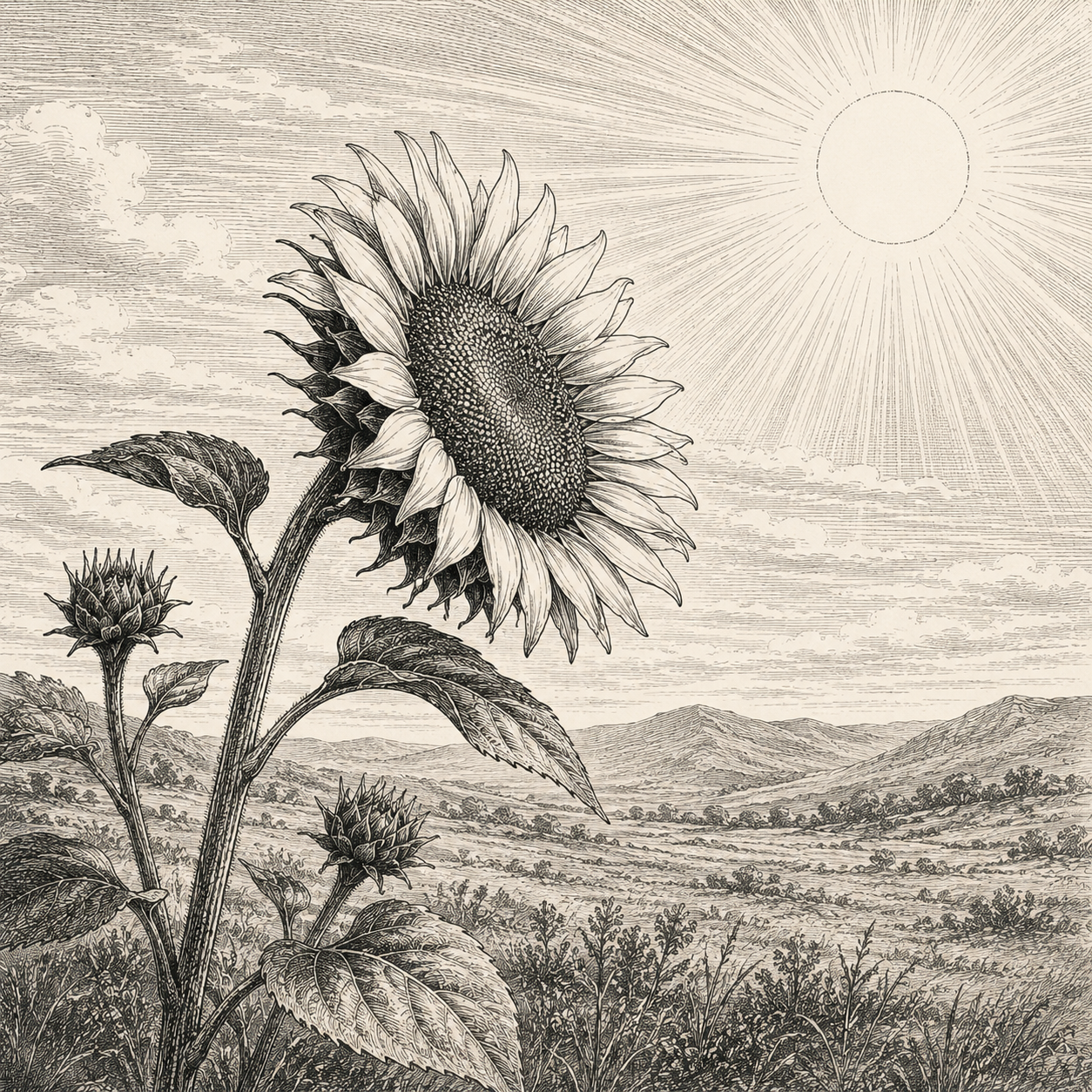
A sunflower turning toward the sun
Michael Pollan has a new book coming out about consciousness, and I've been sitting with an interview he gave New Scientist this week (April, 2026) . Three things he said stopped me cold. I want to share them with you because all three speak directly to what we're exploring together in Tracking Triggers.
Feelings come first
Pollan spent time with the work of neuroscientists Antonio Damasio, Mark Solms, and Anil Seth, and came away persuaded of something that turns a lot of common assumptions upside down.
Consciousness, they argue, doesn't begin in the cortex, which is the newest, most evolutionarily recent part of the brain, the part we associate with thinking, reasoning, and language. It begins in the upper brainstem, with feelings. Hunger. Itchiness. Dread. The felt sense that something matters.
Thoughts come later.
This is not a small distinction. It means that when you find yourself in the grip of a triggered state, the part of you that's activated is older and deeper than language. Older, even, than the capacity to reason about what's happening. By the time a thought forms, the feeling has already moved through you. The body already knows.
This is why talking about a trigger, or analyzing it, so often isn't enough. You're arriving after the fact, using a newer tool on an older event. What Tracking Triggers asks you to do is get upstream of the thought, into the feeling itself, and follow the trail from there.
The plant that tracks
Here's the part that surprised me most in the interview, and I suspect it will surprise you too.
Pollan distinguishes between sentience and consciousness. Consciousness, he suggests, involves self-awareness. Sentience is simpler: the capacity to sense your environment, recognize whether changes are good or bad for you, and respond accordingly.
Plants, he argues, are sentient. They have around twenty senses, compared to our five or six. They respond to the sound of a caterpillar chewing a nearby leaf. They send warnings to neighboring plants when a predator appears. They recognize kin and behave differently toward related versus unrelated plants. And strikingly, they respond to the same anaesthetics we do. Give a Venus flytrap an anaesthetic and it stops registering the fly on its surface.
What has the plant lost when it's under anaesthesia? Pollan asks. Some would say consciousness. Certainly its awareness, its capacity to track its environment.
Tracking, in other words, is not a sophisticated human achievement. It is something far more ancient. Something woven into living systems long before brains appeared. The San trackers that inspired me in Namibia, didn't invent tracking. They recovered and refined a capacity that life itself has been practicing for hundreds of millions of years.
When I invite you to track your triggers, I'm not asking you to acquire a new skill. I'm asking you to come back to something already in you, something that predates thought, predates language, predates everything we think of as distinctly human.
The problem versus the experience
Late in the interview, Pollan describes a turning point. He'd been chasing the problem of consciousness, increasingly frustrated that it resisted solution. His wife, an artist, suggested that not knowing is itself valuable. He wasn't ready to hear it.
Then he spent time with Zen teacher Joan Halifax, and something shifted.
"Focusing on the problem got in the way of the experience," he said.
I read that sentence several times.
It's what happens when we approach our triggered states as problems to be solved rather than experiences to be tracked. We bring analysis, self-criticism, the urgent desire to figure it out and make it stop. All of that is cortex. All of that is the newer, slower tool applied to something ancient and fast.
Tracking asks for something different. Not indifference to the problem, but a willingness to be in the experience long enough to follow where it leads. To stay with the feeling rather than immediately reaching for an explanation.
Pollan ends by saying that even if you finish his book knowing less about consciousness than when you started, you might come away with something more valuable: a deeper appreciation for the astonishing complexity of your own inner life.
That's a reasonable description of what I hope Tracking Triggers offers too.
Not a solution. A practice. A way of paying attention that makes you, as Pollan puts it, more conscious than you were before you started.
Continue the Journey
Tracking Triggers is more than a book. It is a living exploration of how we move from reactivity to responsiveness.
The Inner Trackers are a small community walking this path together, receiving occasional reflections, new journal entries, and a first look at the work as it unfolds.
If this resonates with you, I'd be glad to have you join us.