
The Tracker’s Now!
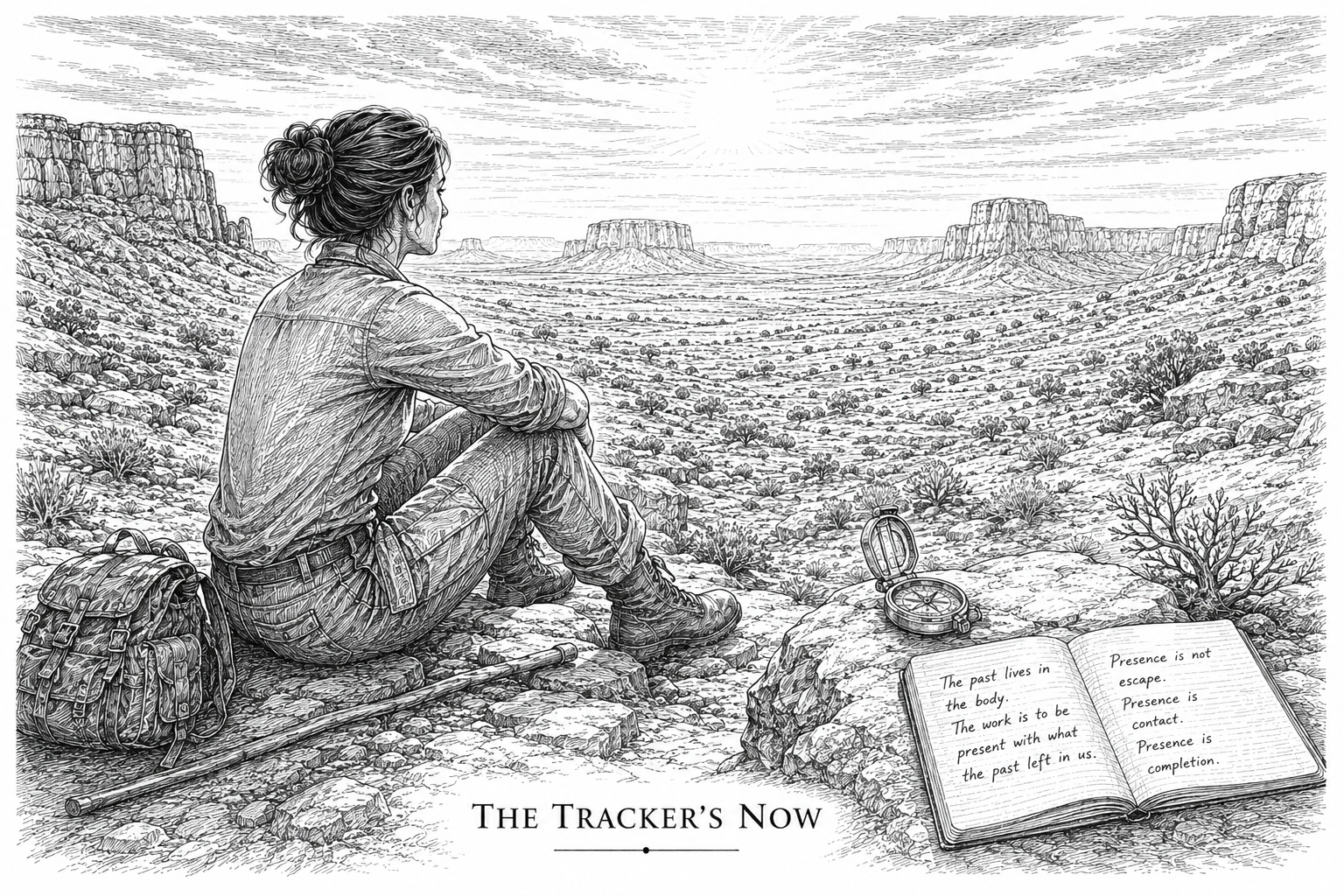
I love Eckhart Tolle. The Power of Now opened something in me years ago that I don't think I would have reached on my own. His invitation to drop the relentless chatter of mind, to step out of the time-bound self and into the simple suchness of this moment, is one of the great spiritual gifts of our era. Millions of people have found relief through his work. I'm one of them.
And yet.
I've always sensed something missing in his teaching. Tolle tells you the destination beautifully. He's less generous with the path. When he writes "nothing ever happened in the past that can prevent you from being present now," I understand what he's pointing to. He's pointing to the freedom that arrives when you stop being possessed by what already happened. He's pointing to the moment of recognition, often arriving with a shock, that the suffering you've been carrying is not the moment itself but your relationship to it.
That's real. That's true. And it's not enough.
Rob Brezsny published a piece this week (May 12, 2026) called "The Tyranny of the Eternal Now," and his quarrel is exactly with this missing piece. The past, Brezsny writes, lives in the body. The nervous system carries it. The autonomic system fires in response to old cues whether or not your conscious mind has signed off. When someone with a trauma history enters what should be a neutral situation and finds themselves in fight-or-flight, they are not failing at presence. They are being touched by what the past left in them.
Telling that person that "the past has no power over the present moment" isn't liberation. It can leave them feeling they've failed at the very practice that promised them relief.
Michael Brown, another teacher in the same lineage, puts it differently. "We do not heal by understanding the past. We heal by being present with what the past left in us."
That last clause is what Tolle, in his most-quoted moments, leaves out. Being present with what the past left in us. Not being present instead of the past. Not being present as escape from the past. Being present with it. In contact with it. Letting it touch us so it can finally complete.
This is where tracking begins.
Sometimes the tracking work begins at 3am. You've handled the situation. You've spoken your truth, set the limit, gone to bed feeling settled. And then you wake with your chest tight and your mind looping, and the present moment now holds an old grief that wasn't on the agenda a few hours before.
You haven't failed presence. Presence has arrived.
The question is what you do then. Tolle, on the surface, would say: notice the loop, let go of it, return to the breath, come back to the now. And that's not wrong. It's just incomplete. Because the loop isn't a failure of attention. The loop is the past speaking through the body, asking for something. If you only return to the breath, the loop returns the next night, and the night after, and the night after that.
The tracking response is different. You stay with what's in the body. You let the chest be tight. You let the looping happen without trying to fix it. You ask: what is this echoing? What does it want? Sometimes a memory surfaces, sometimes it doesn't. Either way, the charge in the body begins to move when you stop trying to drop it and start letting it complete.
This is what being triggered actually is. An emotional reaction to a present event, activated by the charge of something unintegrated from your past. The activation isn't a failure of presence. The activation is the past finally meeting the conditions to be felt.
Near the end of his piece, Brezsny lists the capacities mature work with the past requires. As I read them, I saw the Fifth Way looking back at me:
Notice when a current reaction is disproportionate to what's actually triggering me now. This is Recognize. The first movement. Catching yourself in the moment of activation and registering that you've been triggered. Brezsny names disproportionate intensity as the marker, and often it is. But not always. Sometimes the trigger surfaces as a quiet ache, a familiar tenderness, a subtle grip. The marker is the echo, not the size of the reaction.
Know the difference between insight and compulsion. This is Regulate. Returning to enough ground that you can think, that you can tell a felt understanding from a reactive grip. Without regulation, every insight is just another wave you're being tossed by.
Feel compassion and respect for my younger self who formed that reaction pattern in innocence. This is Name, in its fuller sense. Naming the feelings and needs the younger self couldn't name then, and meeting them with the compassion that wasn't available at the time. Name isn't just labeling. It's asking what else is present alongside the hurt or anger. It's noticing the hope, the tenderness, the inner lion's compassion that emerges when the difficult feelings have been honored. The both-and of hurt and hope, anger and compassion.
Process unintegrated experiences from the past so they stop running me from the shadows. This is Feel and Act Anew. The fourth movement. Letting the charge that was never fully felt finally move through, and acting differently when the pattern returns so the nervous system encodes a new possibility.
Consciously choose a response that serves the real present rather than the conditioned past. This is Respond. The fifth movement. Engaging the actual situation in front of you, from your feelings, needs, and values, instead of running the old survival adaptation on a present that doesn't call for it.
Brezsny adds two more capacities: accountability for how our wounds may wound others, and the humility to accept that this work is never finished. Both sit alongside the Fifth Way as the stance it asks of us.
The exact practice Brezsny is calling for is what tracking offers.
So here's my "yes, and" to Tolle. Yes, life is lived now. Yes, the suffering of psychological time, the rumination and the dread, is something to be released. Yes, the present moment is the only place anything ever happens. And the now we arrive at is never an empty room. The now we arrive at contains everything the past has left in us. The practical work, the work Tolle's teaching invites but rarely names, is learning to be with what's there.
Presence isn't escape from the past. Presence is the willingness to feel what the past left in us, here, now, in the body, on the trail.
That's tracking. And it's the practical bridge Tolle's promise has always needed.
Continue the Journey
Tracking Triggers is more than a book. It is a living exploration of how we move from reactivity to responsiveness.
The Inner Trackers are a small community walking this path together, receiving occasional reflections, new journal entries, and a first look at the work as it unfolds.
If this resonates with you, I'd be glad to have you join us.