
Empathy and the Art of Tracking: How Mediators Follow the Trail of Emotion
"I don't know where we are going, but I know exactly how to get there." —Master Tracker Rhenius
This paradox captures something essential about both tracking and mediation.
The tracker in the African bush doesn't know where the animal is heading, but knows exactly how to follow the trail—reading the subtle signs in sand, grass, and shadow that reveal the animal's path. Step by careful step, the tracker moves forward with confidence, not because the destination is predetermined, but because the process is trustworthy.
Mediators face the same paradox. We don't know where the conversation will lead, what will surface, or how resolution will take shape—if at all. We don't predetermine outcomes. And yet we're not lost. We have skills, processes, and a stance that allows us to follow the trail wherever it goes—one careful, empathic step at a time.
Like the San trackers of the Kalahari—who can read a landscape that appears empty to the untrained eye and find the animal that passed through hours before—mediators learn to read the emotional terrain of conflict. We listen for more than words. We follow the subtle spoor of tone, posture, silence, and story to discover what's really alive beneath the surface. We track it to its source.
I. The Terrain of Conflict
Conflict is emotional territory. Beneath every dispute about boundaries, money, responsibilities, or respect lies a landscape of feelings and needs—some visible, many hidden. The facts of the case matter, but they rarely tell the whole story. What drives conflict, sustains it, and ultimately resolves it lives in the emotional terrain.
But this terrain isn't random. When people are triggered—when their response is bigger than the moment seems to warrant—predictable patterns emerge. Certain emotions cluster together. Certain needs call out. Certain stories take hold.
The challenge is that most people don't arrive in mediation saying, “I feel hurt and I need acknowledgment.” They arrive saying:
"He's impossible to work with. I feel like I'm being micro-managed!"
"She never listens. I feel ignored and totally left out."
"I feel completely disrespected."
They arrive in story, in judgment, using faux feelings—conclusions about what someone else did, dressed up in the language of emotional experience.
The mediator's task is to receive what's offered, recognize it for what it is, and track beneath it to what's actually alive. Not to correct or challenge, but to acknowledge and name—creating the conditions where the person can hear themselves differently.
This requires heuristics. The emotional landscape is too complex to navigate by intuition alone, especially under the pressure of live conflict. We need maps, patterns, frameworks that tell us where to look. The tracking sequence I'll introduce—what I call the "watering hole"—provides exactly this: a systematic way to scan the emotional terrain and identify what's present.
But before we can track, we need to understand why tracking matters—and what happens when we name what's real.
II. Why Tracking Matters: The Neuroscience of Acknowledgment
The foundational narrative of participants in mediation is that the other person is the problem. They're thoughtless, controlling, dismissive—pick your villain. The storyteller is the victim. And you, the mediator, are expected to rescue them.
This isn't a conscious choice. It's the architecture of how we explain behavior.
The Paradoxical Theory of Change
Fortunately, all is not lost. The paradoxical theory of change from Gestalt therapy—now neurobiologically validated—offers a path forward: transformation happens when people become what they are, not when they try to become what they're not.
When someone hears their inner world accurately named and acknowledged—not fixed, not invalidated, just named—something shifts. You might hear them say, "I know I'm making him into a villain, but..." or "I guess part of me wonders if I..." or "Maybe it wasn't quite as bad as I'm making it sound."
These are the moments mediators listen for. The victim stance softens. Agency returns. Now the mediator can work. But what makes this shift possible?
Why Accurate Naming Matters
This isn't just being nice. It's neurobiologically necessary.
Matthew Lieberman's research demonstrates: naming what you feel engages the prefrontal cortex and quiets the amygdala's alarm. Daniel Siegel calls this "name it to tame it." The person moves from survival mode into presence. They become capable of flexibility, perspective-taking—things unavailable when locked in reactivity.
Lisa Feldman Barrett's research on emotional granularity reveals something crucial: people who can make fine distinctions between emotional states—disappointed vs. discouraged vs. devastated—have lower stress markers, fewer depressive symptoms, and better coping outcomes.
Why? Because precision creates options. When you can only say "I'm upset," you're stuck in global overwhelm. When you can say "I'm disappointed, apprehensive, and a bit resentful," you've identified the specific emotional landscape. When you can further say "and I need acknowledgment, autonomy, and trust," you've identified paths forward.
You're not naming to make the feeling go away. You're naming to be fully present with what's actually here. Acknowledgment is a powerful neurobiological necessity.
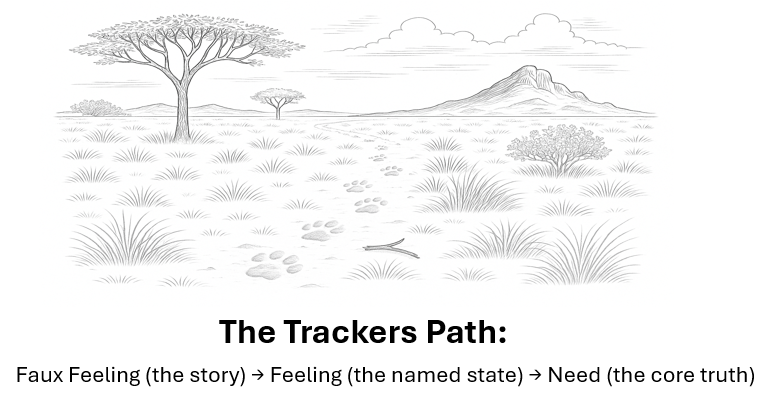
III. The Tracker's Path: From Faux Feeling to Need
To name accurately, we need a path to follow—a clear sequence that takes us from the surface story to the truth beneath. I call this the tracker's path: from faux feeling (the story) to feeling (the named state) to need (the core truth). People arrive with conclusions.
The mediator's task is to track beneath the story to the feelings—and beneath the feelings to the needs that give them shape. This is the path from reactivity to understanding.
Here is the tracker's path:
Faux Feeling (the story) → Feeling (the named state) → Need (the core truth)
IV. Critical Distinctions: Emotions, Feelings, Faux Feelings, and Needs
Before we can track to the truth beneath, we need clarity about what emotions, feelings, faux feelings, and needs actually are. Most people use these words interchangeably, but they name different phenomena—and the distinction matters for mediators.
Emotions: The Body's First Response
Emotions arise fast—often before we're consciously aware. They come through the body first, in raw form: chest tight, breath shallow, heat rising, jaw clenched, stomach dropping, shoulders curling inward.
This is the work of our older, faster brain regions, designed for immediate survival. Emotions are bodily, brief, and instinctual—the neurochemical cascade that happens before conscious thought can intervene.
When you see something alarming, your heart rate spikes and your muscles tense before you've consciously registered what you're looking at. That's emotion: automatic, rapid, subcortical.
Feelings: The Mind's Interpretation
Feelings are the subjective experience of emotional states—the conscious awareness that arises as the neocortex begins to name and interpret what's happening. Where emotions are raw and reactive, feelings are processed, nuanced, and shaped by thought.
By the time you can say "I feel anxious" or "I feel disappointed," you've moved from emotion into feeling. The neocortex has come online, interpreting the body's signals, drawing on memory and context, constructing a meaningful experience from the raw data.
Faux Feelings: Conclusions in Disguise
When someone says "I feel disrespected," they're well past the emotion stage. They're in the territory where feelings should emerge. But instead of generating a genuine feeling—hurt, scared, angry—they're generating something else: a faux feeling, a judgment masquerading as a feeling.
Faux feelings are neither emotions (too late for that) nor feelings (even though they use feeling-language). They're conclusions about what someone else did. They point the lens outward rather than inward. "I feel disrespected" means they violated my boundaries. "I feel ignored" means they chose not to see me. "I feel betrayed" means they broke their commitment to me.
Each one implies motive and assigns blame. Each one keeps the speaker locked in a story about what was done to them rather than connected to what's alive in them. They lock you into a victim narrative—where the other person is the problem and you are powerless.
Needs: To Survive and Thrive
Needs—both physical and psychological—are what all humans require to survive and thrive. Some are concrete: air, water, food, shelter, rest. Others are relational and existential: safety, trust, belonging, autonomy, understanding, meaning.
Our needs can be threatened through what happened (trauma, violation, harm) or through what didn't happen (chronic absence, neglect, unmet needs over time). And our relationship to expressing needs is shaped by what we learned early on. Some of us learned that needs are safe to express. Others learned that expressing needs makes you needy, weak, or a burden—perhaps through messages like "You're so demanding. Why do you need so much attention? Stop being so sensitive!"
When expressing needs feels this dangerous, faux feelings offer protection. It's safer to say 'I feel disrespected' (pointing outward) than to say 'I feel hurt and I need to matter to you' (revealing the vulnerable need beneath).
Why This Matters for Mediators
When someone offers a faux feeling, they believe they're sharing how they feel. The mediator's task is to recognize what's actually being offered—a conclusion, not a feeling—and track beneath it to the genuine feelings and needs underneath without being captured by the story yourself. This isn't about correcting them ("That's not really a feeling"). It's about knowing where you are on the map, so you know where to go next.
But to track effectively, we need to understand why faux feelings arise so quickly and feel so convincing.
V. The Predictive Brain and Why Faux Feelings Form
There are two currents running through every human life.
One is ancient. It rises from the body—swift, direct, shaped by millions of years of survival. This current lives in the autonomic nervous system, where fight, flight, freeze, and fawn still wait like well-worn trails across familiar ground. These are the routes we inherited, the ones that move faster than thought.
But there is another current—quieter, slower, more deliberate. It is the part of us that can choose which trail to take, and whether to forge a new one entirely. It asks: What does this moment actually need? And then it acts.
The fast path runs through the amygdala, which scans for threat and reacts before thought arrives. The slow path engages the cortex, which gathers more information, refines perception, and creates space for conscious choice.
Why do faux feelings arise so quickly and feel so convincing? Because they travel the fast path.
Lisa Feldman Barrett's research on constructed emotion reveals that the brain is fundamentally a prediction engine. It doesn't wait for sensory data to arrive and then figure out what's happening. It predicts what's most likely to happen based on past experience, then checks incoming signals against those predictions.
This is efficient—most of the time, predictions are accurate enough. But under emotional strain, when old wounds are activated, the prediction engine can hijack perception entirely. Before the slow path can check what you actually feel, the fast path has already delivered its conclusion: They're dismissing me. They're trying to control me. I'm being left out.
The faux feeling isn't discovered; it's delivered by a brain trained to see threat, confirm old patterns, and cast you as victim before the moment has fully landed.
The Biases That Build the Story
Several cognitive biases reinforce this predictive distortion:
Attribution error is particularly insidious. We tend to explain our own behavior by circumstance—'I snapped because I was stressed'—but explain others' behavior by character: 'They did that because they're thoughtless' or 'because they don't care.'
The implicit judgment is even more damaging: I couldn't help it. They chose to act. This double standard is the cognitive architecture of victimhood: I'm reacting to what's being done to me with no choice, but they're acting from who they are with full intent. It shrinks our empathy, justifies our reactions while turning theirs into proof of their flaws."
Confirmation bias joins in once the narrative takes hold. We gather evidence that supports our conclusion and ignore details that don't fit. Every neutral interaction gets read as dismissive. The prediction loop tightens.
The leap from impact to motive completes the picture. We feel hurt, and the mind instantly supplies a reason: They did that on purpose. They wanted to hurt me. These aren't perceptions—they're stories layered onto sensation. Yet when the emotional charge is high, the story feels self-evident.
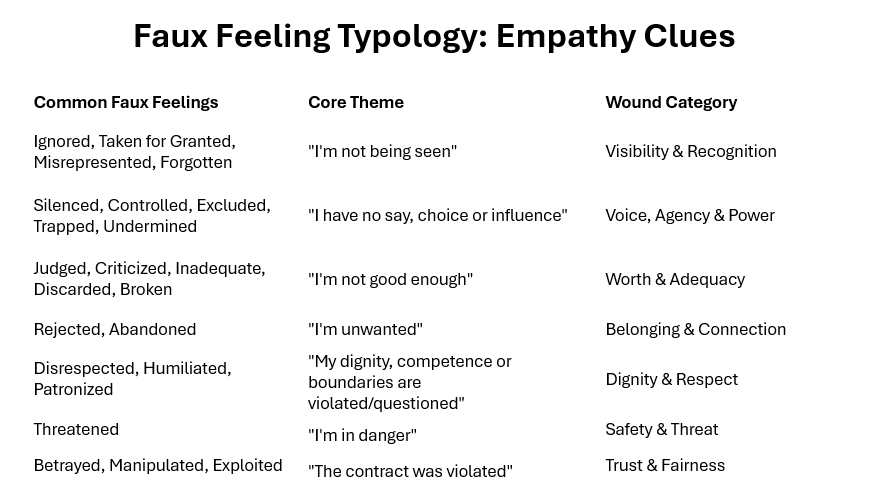
VI. The Wound Categories: A Diagnostic Frame
Not all faux feelings are the same. They cluster into wound categories—distinct territories of human vulnerability. Recognizing which wound has been touched helps the mediator know where to look.
When you hear "I feel disrespected," you're likely in dignity wound territory. Disrespect strikes in three ways:
o your boundaries are crossed—your "no" brushed aside, your limits ignored;
o your competence is questioned—your expertise doubted, your judgment challenged by someone with no standing to do so;
o or your dignity is dismissed—you're spoken to as less-than, your presence treated as optional, your humanity disregarded.
The story "I feel disrespected" rises like a wall. It sounds like a feeling, but it's actually a verdict: You don't see me as someone who matters. Beneath it live anger, hurt, and needs around respect, boundaries, and recognition.
When you hear "I feel controlled" or "I feel trapped," you're in agency wound territory—frustration, powerlessness, and needs around autonomy and choice.
When you hear "I feel rejected" or "I feel abandoned," you're in belonging wound territory—sadness, loneliness, and needs around connection and acceptance.
When you hear "I feel ignored," "taken for granted," "misrepresented," or "forgotten," you're likely in visibility and recognition wound territory.
When you hear "I feel silenced," "excluded," or "undermined," you're in voice, agency, and power wound territory.
When you hear "I feel judged," "criticized," "inadequate," "discarded," or "broken," you're touching worth and adequacy wounds.
When you hear "I feel betrayed," "manipulated," or "exploited," you're in trust and fairness wound territory.
When you hear "I feel threatened," you're in safety wound territory.
When you hear "I feel unprepared," you're touching competence wounds.
When someone says "nothing matters," you're likely touching meaning and vitality wounds.
This isn't a rigid classification—faux feelings often cluster, with multiple wounds activated simultaneously. But the categories give mediators a quick diagnostic: What wound am I likely touching? What feelings and needs live in that territory?
VII. What Empathy Actually Is
“Empathy...is not merely a personality trait, but fulfills a methodological function...[W]ithout a minimum level of empathic resonance, it is difficult to create a safe space in which interests (needs) and emotions (feelings) can be openly discussed.”
—Michael Lardy, Swiss mediation trainer
https://mediate.com/ai-empathy-in-mediation-when-algorithms-show-compassion/
Defining Empathy
Empathy refers to the capacity to understand and share another's feelings and needs from their perspective, communicating this understanding with sensitivity.
Empathy is about entering another person's frame of reference—not to agree with them, not to fix them, but to understand what's alive in them from the inside out.
Empathy Is Not Sympathy
Sympathy draws on your own experience. When someone tells you about their loss, and you respond with "I know exactly how you feel—I went through the same thing last year," you're being sympathetic. Your experience enters. The focus shifts. Now they're hearing about your loss.
Empathy enters their frame of reference. With empathy, you set aside your own viewpoint and step into theirs. The focus remains entirely on them—how they make sense of their feelings, what they need, what the experience means to them: "I imagine you're devastated. You put so much into this—that's a real loss."
Sympathy can open the door. Empathy walks through it.
Four Attributes of Empathy
Theresa Wiseman identifies four defining attributes of empathy. The first is perspective-taking—seeing the world as others see it by setting aside your own viewpoint to enter their frame of reference. It doesn't require agreement, only accurate understanding.
The second is being non-judgmental. Empathy collapses the moment we evaluate or minimize another's experience. Non-judgment creates psychological safety.
The third is understanding another's feelings—recognizing the emotional tone, sensing the feeling beneath the story, being attuned to the emotional meaning.
The fourth attribute is communicating that understanding. Empathy is incomplete until it is expressed back in a way the other person can recognize. This last attribute is crucial. It's not enough to understand—you must communicate that understanding. Empathy completes itself in expression.
Empathy as Translation: Tracking to Feelings AND Needs
Marshall Rosenberg's work in Nonviolent Communication provides a critical insight: "In offering empathy the goal is to translate the message being expressed into feelings and needs." Beneath every complaint, criticism, or demand lies a genuine feeling pointing to an unmet need.
When someone says "I feel ignored," they're pointing beneath the faux feeling to hurt (feeling) and recognition (need). "I feel controlled" points to frustration (feeling) and autonomy (need). The mediator's task is to track both—not just the feeling, but the need beneath it. This becomes the empathy guess—a speculative tracking move we'll explore later. But first, we need to understand how empathy operates.
VIII. How Mediators Track: Systematic, Speculative, and Intuitive Perception
In "The Art of Tracking: The Origin of Science," Louis Liebenberg describes how San trackers use three modes of tracking:
1. Systematic tracking: the art of seeing what's there. Careful, methodical observation of visible signs.
2. Speculative tracking: the imagination enters. When visible signs disappear, the tracker imagines where the animal might have gone based on knowledge of the species, terrain, and behavior.
3. Intuitive tracking: when knowing arrives unbidden. The tracker just knows—because expertise becomes invisible to itself. And sometimes, no-one knows how!
Mediators track emotions the same way:
1. Systematic Tracking: Following Visible Signs
Systematic tracking involves following clear, visible signals. Like a tracker following a clear hoofprint, you're reading what's directly observable.
This mode demands discipline. The mediator must notice what others overlook and read the three channels of communication: words (the explicit content), tone (the emotional signal conveyed through pitch, pace, and volume), and nonverbal cues (posture, gesture, facial expression).
When these channels align, understanding flows easily. When they contradict—when the words say "I'm fine" but the body collapses—we instinctively trust the nonverbal.
Silence is its own signal. When someone goes quiet, they haven't stopped communicating—they've shifted channels. Silence can signal processing, overwhelm, resistance, protection, or depth. The mediator who rushes to fill silence often breaks the trail.
But here's the challenge: we don't perceive raw signals. They're filtered through our own wounds, predictions, and biases. Genuine perception requires recognizing these filters and setting them aside. Are you seeing them through the lens of your own triggers? Are you projecting your story onto theirs? Are you assuming you know before you've really listened? Systematic tracking asks: What is this person actually offering? Not what do I think they should be feeling, but what are they revealing right now?
2. Speculative Tracking: Imagining When the Trail Fades
What happens when the visible signs disappear? When the person can't name what they're feeling, or says one thing while their body says another? When they're so locked in story that no feeling seems present?
This is where speculative tracking begins. The mediator must imagine the person's inner experience—based on what they know of human emotion, the wound categories, and common emotional patterns. They reconstruct the likely scenario: If they're saying "disrespected," they're probably in dignity wound territory. What feelings live there? What needs?
Speculative tracking is not guesswork—it's structured imagination grounded in deep knowledge of emotional patterns. You don't know for sure. But you have a hypothesis based on everything you've perceived and everything you know about how emotions cluster.
In practice, speculative tracking becomes the empathy guess—a tentative reflection offered for confirmation or correction. We'll explore this technique in detail shortly. But first, there's a third mode of tracking to consider.
3. Intuitive Tracking: When Knowing Arrives
Some trackers, after years of practice, develop what appears to be intuition. They look across a landscape and simply know where the animal is heading. What looks like intuition is often expertise that has become invisible to itself. The patterns you've seen a thousand times now register before conscious thought engages.
The same happens with empathic tracking. At first, using the heuristics and frameworks for emotional tracking feels mechanical. But with practice, the steps dissolve. Perception and imagination converge. You just know—not through analysis, but through pattern recognition that's become unconscious. This is skill becoming second nature.
And yet the old San trackers speak of something more mystical: moments when the animal calls to them, when the land itself reveals what cannot be seen. They don't dismiss this as superstition. They trust it—because years of discipline made them available to receive it. Understanding arrives whole rather than assembled from parts—a grief they haven't mentioned, a need beneath the anger you couldn't have reasoned your way to.
The learnable skills build the foundation. Presence opens the door. What comes through may exceed explanation. Trust it—but verify it. Even genuine knowing needs testing.
IX. The Empathy Formula
The first two modes of tracking—systematic and speculative—can be distilled into a formula:
Systematic + Speculative = TRACKING
Genuine Perception + Deep Imagination = EMPATHY
With practice, these two modes integrate and become intuitive. But first, we need to understand what each produces.
Genuine Perception: The Foundation of Systematic Tracking
Genuine perception is what systematic tracking produces—direct understanding of what's actually there, with minimal distortion from your own history. This means reading the signals in front of you (words, tone, body language) without filtering them through your own wounds, projections, or reactive patterns. It means perception not distorted by cultural imprints and implicit biases. Perception that sees them, not your story about them.
Deep Imagination: The Work of Speculative Tracking
Deep imagination is what speculative tracking requires—the creative act of mentally journeying into another's experience. Not just observing from outside, but imagining what it's like to be them, to live in their world, to face their constraints. It requires imagination grounded in genuine curiosity and active effort—imagination that doesn't project what you would feel or reflect the role you've already cast them in.
Genuine perception keeps you accurate. Deep imagination keeps you connected. Together, they constitute empathy: the capacity to understand and share another's feelings and needs from their perspective. Master these two, and the third mode—intuitive tracking—emerges on its own. The formula becomes invisible, and knowing arrives unbidden.
X. The Empathy Guess: Speculative Tracking Made Verbal
In Nonviolent Communication, Marshall Rosenberg developed a technique for turning speculative tracking into practice: the empathy guess. The basic structure is simple—feeling plus need, offered as a question:
"Are you feeling hurt—maybe even angry—because you're needing your contributions to be acknowledged?"
Notice what's happening: you name a feeling (hurt, angry), you name a need (acknowledgment), and you offer it tentatively, as a question. Variations include "It sounds like you're feeling..." or "I'm sensing you might be feeling..." or "I'm wondering if you're feeling..."
What makes empathy guesses powerful is precisely their tentativeness. They communicate two things at once: I am trying to understand you and only you can confirm what's true for you. The guess keeps the focus on the speaker, avoids presumption, and invites correction.
When you can't see the trail clearly, the empathy guess becomes your primary navigation tool. You're not declaring what's true—you're offering a possibility: "I'm not sure what's happening right now, but I'm wondering if there might be some disappointment underneath?" Notice the explicit acknowledgment of uncertainty. You're modeling that not-knowing is acceptable. You're inviting collaborative exploration.
If you're right, they feel seen. If you're wrong, their correction teaches you. Either way, you're tracking together. The loop closes. You've tracked from the faux feeling to the genuine feeling and need. Now the person feels heard, and the mediator can work.
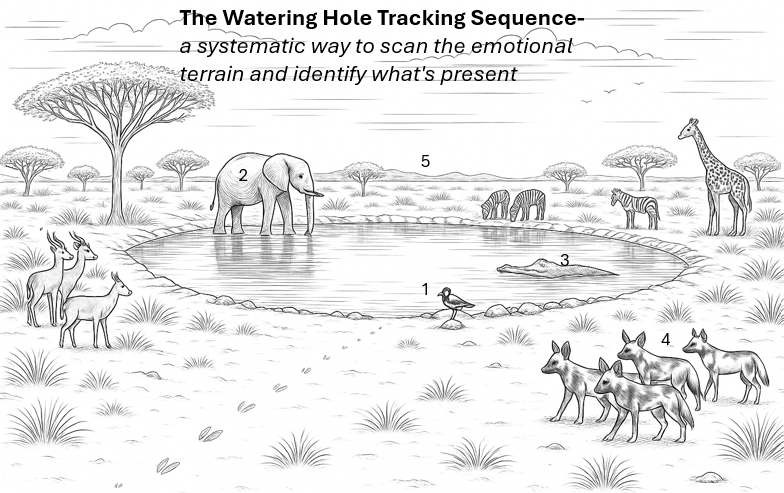
XI. The Watering Hole: A Tracking Sequence
Now that we understand empathy—what it is, how it works through three tracking modes, what it produces (the formula), and how to apply it (the empathy guess)—we need a systematic way to scan the emotional terrain.
Imagine you are standing at a watering hole in the African bush at dusk. Many animals have gathered—elephants, rhinos, lions, crocodiles, wild dogs, plovers at the edge. They don't arrive randomly. Each occupies a particular niche, shows up at particular times, behaves in predictable ways.
The emotional landscape of triggered conflict works the same way. When someone is activated, certain emotions show up first, others wait at the edges, and some lurk beneath the surface. Understanding this sequence gives mediators a systematic way to scan the terrain.
1. Gateway Emotions: The Plovers
The first signal that something is happening often comes from the edges—the blacksmith plovers whose alarm call rings out: Pay attention. Something's happening. Orient now.
Gateway emotions work the same way. When something unexpected happens, three responses arrive first. Startle is the body's immediate flinch, pure reflex, over in seconds. Surprise is brief and neutral—something unexpected, what is this? Shock is heavier, disorienting—something significant just happened that doesn't fit, this can't be real.
Gateway emotions grab attention and open the door to what comes next. They don't carry meaning yet—they just signal that something has landed. These often serve as entry points. Someone says "I'm shocked" or "I'm surprised," and the mediator tracks deeper: "What lives beneath that shock?"
2. The Big Three: Elephants
Three emotions form the foundation: anger, fear, and sadness. They're the elephants—powerful, commanding, claiming space the moment they arrive.
Anger rises when something the person cares about is threatened. It shows up on a spectrum from irritated to furious. Anger often reveals needs for respect, fairness, autonomy, to be heard, boundaries honored.
Fear shows up when stability, safety, or predictability feels threatened. It ranges from uneasy to terrified. Fear often reveals needs for safety, security, predictability, trust, clarity.
Sadness acknowledges what's gone or diminished. It ranges from disappointed to devastated. Sadness often reveals needs for acknowledgment, connection, belonging, being seen.
Most triggered states involve one or more of these beneath the surface. If someone is activated, at least one of the Big Three is likely present.
3. The GSP Complex: Crocodiles in the Water
Guilt, shame, and pride are the crocodiles—lurking beneath the surface, often invisible, then striking when vulnerability is exposed. They're guardians of social belonging, watching for threats to worthiness, acceptance, and place in the group.
Guilt focuses on what the person did or did not do, not who they are. Sometimes guilt is conscience aligning with values—genuine remorse that prompts reflection, apology, and repair. This kind of guilt moves you toward change. But sometimes guilt doesn't resolve. It becomes rumination without transformation, or may spiral into shame (I did something bad becomes I am bad), or become a substitute for actual change—endless apology without different action.
Shame can show up in two ways. Sometimes shame is about what you did: "I should be ashamed of what I did." The act was shameful. Sometimes shame is about who you are: "I AM bad. I AM defective. I AM unworthy—not just in this moment, but fundamentally, always." This is when shame becomes identity. The self is the problem, not the behavior. It leads to collapse and silence.
Pride also takes two forms. Sometimes you feel proud—that warm swell of feeling good about yourself, grounded self-respect. Sometimes pride shows up as protection—not a feeling but armor constructed to keep you safe. When shame or hurt becomes unbearable, pride steps in: "I don't need anyone. I'm fine on my own." This protective pride covers underlying vulnerability.
These feelings often block access to vulnerability. The mediator listens for them—not to call them out, but to track around them. Notice, sense, hold lightly—and surface with great care.
4. Connecting Feelings: Wild Dogs at the Periphery
After the intensity of the Big Three and GSP, look to the periphery. There, moving in coordinated groups, are the wild dogs—hope, curiosity, care, compassion.
These connecting feelings don't arrive instead of the difficult feelings but alongside them. They signal resilience and relational capacity. They emerge when the person has been honest about the hurt and had that hurt acknowledged. When someone feels truly heard in their pain, curiosity and care can show up alongside the anger.
The key insight: connecting feelings aren't about "getting over" the hurt - they're what becomes possible when the hurt is witnessed and validated.
Someone might say: "I'm still hurt. And I also want to understand what happened for them." This is the shift from victim narrative to agency. When you hear hurt AND curious, angry AND hopeful—that's the fuller landscape emerging. When these feelings are accessible, the person can engage with flexibility.
5. The Fuller Landscape: The Whole Watering Hole
Now step back and see the whole scene. There are subtler feelings you might not notice unless you deliberately scan—perplexed, ambivalent, tender, wistful, vulnerable, powerless, disappointed, relieved, hopeful, resentful, disconnected, numb, overwhelmed.
Just as a tracker needs to know which animals inhabit the region, mediators need a vocabulary of feelings and needs. The Empathy Set® provides lists of feelings and needs organized for quick reference. Think of these as your field guide—not to prescribe what someone should feel, but to help you recognize what's there.
The cards offer vocabulary and let people recognize themselves. You're not telling them what they feel—you're offering language and creating space for discovery.
Let them identify what resonates. Often they'll find words they didn't know they had: Vulnerable. Disconnected. Longing.
The mediator doesn't need to name them all. The task is to track from the faux feeling to a cluster of genuine feelings that point toward needs. This is the watering hole: a systematic way to scan the emotional terrain and offer empathy guesses that land.
XII. When Tracking Gets Difficult: Meeting Victim Narratives
The most challenging moment in mediation often comes when someone is locked in a victim narrative—anchored in faux feelings, rehearsing the case against the other person, unable to access what they're actually feeling beneath the story.
The temptation is to challenge: "But have you considered their perspective?" These interventions almost never work. They land as invalidation. The person doubles down.
Curiosity as Stance
The victim narrative is a protective strategy. It keeps the person from feeling powerless by locating the problem outside themselves. Challenging it directly only entrenches it.
Instead, stay with the story longer than feels comfortable. Let them tell it fully. Reflect the faux feeling without endorsing it: "You're saying you feel completely disrespected by what happened." This acknowledges what they're experiencing without claiming it's the whole truth.
Then track beneath the narrative to the feelings and needs that give it life: "It sounds like you're feeling really hurt and frustrated. You're needing to be heard and have your experience acknowledged."
When the feelings and needs are named, the narrative often softens. The person doesn't need to defend their story anymore—because someone finally understands what it was protecting.
Inviting Reappraisal
Once the person feels fully heard—and particularly once connecting feelings begin to emerge alongside the difficult ones—gentle invitations to reappraisal become possible. These aren't challenges. They're questions that invite without directing.
You might invite them to reinterpret by giving the event a different plausible meaning: "What do you make of all that?" or "Is there another way to make sense of what happened?" or "What else might have been going on for them in that moment?"
You might normalize by placing their reaction in a human, understandable context: "Has anything like this happened to you before?" or "Do you think others might feel similarly in this situation?"
You might invite them to reposition by viewing from another vantage point: "What might this have looked like from where they were standing?" or "If someone outside the situation were watching, what might they notice?"
You might encourage them to reorder by shifting what they prioritize or emphasize: "What else were you noticing in that moment?" or "Is there anything else about how they showed up that matters to you?" or "What else happened that's worth holding alongside this?"
These questions become available once connecting feelings emerge—and only after the person feels fully heard. They invite without directing.
When You're Genuinely Lost
There will be moments when you have no idea what's happening. The signals contradict. Your guesses don't land. This is when your own groundedness matters most. If you can stay regulated—present but not grasping—you create the conditions for something to emerge.
It helps to name your own experience: "I'm noticing I'm not quite tracking what's most important to you right now. Can you help me understand?" This isn't weakness—it's modeling that collaboration is welcome and that they're the expert on their own experience.
The Shift When It Comes
When someone feels fully received—not challenged, just heard—something often shifts. The victim stance softens. Agency returns. You might hear: "I know I'm making them into a villain, but..." or "I guess part of me wonders if..." These are the moments to listen for. Now the mediator can work.
XIII. Conclusion: The Mediator's Stance
"I don't know where I am going but I know how to get there." —Master Tracker Rhenius
You now have tools for the journey: the critical distinctions between emotions, feelings, faux feelings, and needs; the Tracker's Path from faux feeling to feeling to need; the wound categories as diagnostic frame; the watering hole sequence; the three modes of tracking; the empathy formula; the empathy guess.
But these skills—systematic perception, speculative imagination, empathic tracking—operate within a larger container: the mediator's stance itself.
The tracker's wisdom reveals what this requires. The mediator doesn't chase. They wait. They watch. They receive what the landscape offers before they act. You don't force the conversation. You don't push people toward resolution before they're ready. You don't impose your timeline, your agenda, your preferred outcome.
This isn't passivity. It's disciplined receptivity. You track the emotional terrain, receive what people offer, and when the moment arrives—when someone softens, when agency returns—you move.
The deepest skill isn't technique. It's the willingness to be present with what's actually there—without fixing, without rushing, without needing to know the destination before you begin.
The San trackers of the Kalahari move through a landscape that appears empty to outsiders. But to the trained eye, the terrain is alive with signs: bent grass, disturbed sand, the faint impression of a hoof. They follow the trail one careful step at a time, trusting the process even when the destination is unknown.
This is the work of the mediator. One careful, empathic step at a time.
John Ford is a workplace mediator, conflict resolution specialist, and creator of The Empathy Set. He develops training programs for UC Law SF's Center for Negotiation and Dispute Resolution and is the author of Peace at Work and the forthcoming Tracking Triggers: From Reactivity to Responsiveness. His work integrates wilderness tracking wisdom from Southern Africa with contemporary approaches to emotional intelligence and conflict transformation. www.empathyset.com and www.trackingtriggers.com